
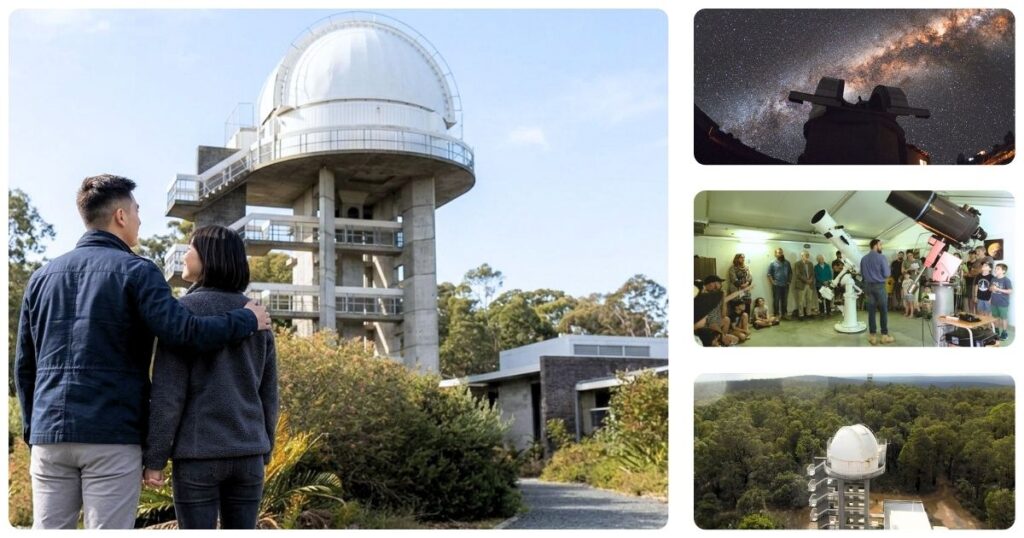
Drive around 40 minutes east from Perth CBD, climbing into the Darling Range, and the city lights fall away behind you. At Bickley, roughly 350 metres above sea level, a white dome appears through the trees: Perth Observatory, whose story starts in 1896 but whose current site dates to 1966, and whose current operation is run almost entirely by volunteers rather than professional astronomers.
That last part matters and is worth knowing before you book. Perth Observatory isn’t the active research institution its heritage status might suggest. Its research programs were cut by the WA Government in January 2013, and since July 2015 it’s been run by the Perth Observatory Volunteer Group, a community of around 120 to 160 registered volunteers and just a handful of part-time staff, under a partnership agreement with the state parks agency. It’s now a tours-only, education and heritage-outreach facility, not a working scientific observatory. That doesn’t make it less worth visiting; it makes it a different kind of experience than the draft “research-active” framing might suggest, closer to a passionate community-run heritage site than a professional science facility.
Who will Enjoy the Observatory Experience
Families with kids aged roughly 8 and up, astronomy-curious visitors who’ve never looked through a proper telescope, and anyone wanting an evening activity well away from Perth’s CBD light pollution. It’s less suited to very young children (the cold, dark, seated-still nature of a 90-minute to two-hour tour is hard for under-8s), or anyone expecting Hubble or James Webb-quality imagery through the eyepiece; ground-based amateur telescopes show real detail, but it’s a different kind of view.
A Complicated History Worth Knowing
The original Perth Observatory was built in 1896 on Mount Eliza, within what’s now Kings Park, and officially opened in 1900 by John Forrest, WA’s first premier. Its early role was keeping standard time for the colony (clocks reportedly varied by up to half an hour before it existed) and recording earthquakes and tides. By the 1960s, expanding light pollution from the growing city and a state government redevelopment plan for Mount Eliza forced a move. The observatory relocated to its current Bickley site in the Darling Range, with staff moving in over December 1965 and the new facility formally opened by Premier Sir David Brand on 30 September 1966.
For decades afterward it operated as a scientific institution, producing star catalogues used internationally, discovering more than 100 asteroids, and contributing roughly 10 percent of the world’s Earth-based tracking positions for Halley’s Comet during its 1986 return. That changed abruptly in January 2013, when the state government cut all research funding and restricted the observatory to public tours only. Rather than close, the facility was handed to a volunteer group in 2015, and it’s run that way today, drawing tens of thousands of visitors a year through night tours, school programs and community events, funded almost entirely by ticket sales and donations rather than government science budgets.
What a Visit Involves
Public night sky tours
This is the standard visitor experience: book ahead (walk-ins aren’t accepted), arrive at dusk, and spend roughly 90 minutes to two hours with a volunteer guide moving between the observatory’s telescopes. Guides talk you through what’s currently visible, from planets and the Moon to seasonal constellations, nebulae and, when conditions allow, galaxies like Andromeda. Current Night Sky Tour pricing is around $50 for adults, $40 concession, and $30 for children aged 5 to 17, though confirm current prices and tour options at perthobservatory.com.au before booking, since the observatory runs several different themed tours (including low-sensory sessions for visitors who find standard tours overwhelming) at varying price points.
School programs
Curriculum-linked sessions for primary and secondary students cover constellations, telescope use and light pollution, scaled to age group. Many Perth Hills schools pair a daytime visit here with a Lesmurdie Falls walk to build a full excursion day.
Astrophotography and special events
The observatory periodically runs astrophotography sessions and themed events (an official Star Trek-branded night tour has run in recent years, for instance). These change season to season, so check current listings rather than assuming a fixed program.
Why Bickley Specifically
The Darling Range foothills give the observatory two real advantages over anywhere in Perth’s suburbs: elevation (thinner atmosphere) and distance from the city’s light dome. It’s not a coincidence that this is the second site chosen for the observatory after light pollution forced it out of Kings Park in the 1960s; the same logic still applies, just more so now that Perth has grown considerably larger. If you’ve only ever looked at stars from the coast or the CBD, the difference in what’s visible from Bickley on a clear night is noticeable, particularly for fainter deep-sky objects that simply wash out under city light.
Getting There and Practicalities
The observatory is at 337 Walnut Road, Bickley, roughly 35 to 45 minutes’ drive east of the CBD via Great Eastern Highway toward Kalamunda, then into the Bickley foothills. There’s no practical public transport option for the final leg to the observatory itself, so this is a car trip for most visitors.
Tours are weather-dependent: cloud cover means the observatory reschedules you or runs an indoor astronomy presentation instead, since there’s not much point standing at a telescope pointed at cloud. Dress warmer than you think you’ll need; even mild Perth Hills evenings drop noticeably once the sun’s down, and winter nights at elevation get cold. Your eyes also need 15 to 30 minutes to properly adapt to darkness, so patience in the early part of the tour pays off later.
Combine With the Perth Hills
Because tours run at dusk, most visitors build a Perth Hills day around the evening booking rather than making a single-purpose trip. Lesmurdie Falls, about 5km south, is a good afternoon walk beforehand (see our full guide for trail options and current conditions). Kalamunda town, roughly 8km away, has cafes and dinner options if you want to eat before heading to the observatory for dusk. Mundaring Weir, further north, is another solid afternoon add-on if you’re spending the whole day in the hills.
What Locals Know
Perth Hills locals and regular visitors know that the busiest, hardest-to-book nights are winter weekends during school holidays, when clear, cold skies coincide with family availability; booking well ahead for those windows is necessary. Locals also point out that the observatory relies heavily on ticket revenue and donations since losing government research funding, so buying tickets directly rather than through third-party resale sites supports the volunteers keeping the place running. Regulars rate autumn and winter (roughly April to August) as the most reliably clear stretch of the year for tours, since Perth’s summer haze and dust can noticeably reduce what’s visible even on technically clear nights.
Is It Worth It?
Yes, with realistic expectations. This is a community-run heritage and education facility rather than a working research observatory, and the telescope views, while good by amateur astronomy standards, won’t match professional imagery. What you’re paying for is knowledgeable, enthusiastic volunteer guiding, a dark sky location, and a slice of WA scientific history that very nearly disappeared entirely in 2013. Book ahead, dress warm, and go in curious rather than expecting a planetarium show.
Frequently Asked Questions
How much does it cost?
Standard Night Sky Tours currently run around $50 adult, $40 concession, $30 child (5 to 17), though pricing and tour types vary. Confirm current prices at perthobservatory.com.au before booking.
Do I need to book ahead?
Yes. Walk-ins aren’t accepted for night tours; book online or by phone in advance, ideally well ahead for winter weekends and school holidays.
Is this a government research facility?
Not anymore. The WA Government cut all research funding in January 2013, and the observatory has been run by the volunteer-led Perth Observatory Volunteer Group since 2015 as a tours and education facility.
What if it’s cloudy on my booked night?
Tours are weather-dependent. A cloudy night typically means rescheduling or an indoor presentation instead of outright cancellation; refunds are less commonly offered than rebooking.
What’s the best time of year to visit?
Autumn and winter (roughly April to August) generally offer the clearest, least hazy skies. Spring is a reasonable second choice; summer haze can reduce visibility even on nominally clear nights.
Is it suitable for young kids?
Children around 8 and up generally manage the length, cold and darkness reasonably well. Younger children often find a full 90-minute to two-hour tour difficult. School group programs are specifically age-calibrated if you’re visiting with a class.
How far is it from Perth, and do I need a car?
Roughly 35 to 45 minutes’ drive east of the CBD via Great Eastern Highway. There’s no practical public transport for the final leg, so a car is effectively required.
The Close
Perth Observatory’s real story isn’t continuous scientific glory, it’s survival. A facility that once tracked Halley’s Comet and helped build international star catalogues lost its research funding entirely in 2013, and only exists today because a community of volunteers decided a 350-metre hill in Bickley with a 130-year astronomical lineage was worth keeping open. Go for the dark sky and the good telescope views, but go knowing you’re also supporting one of WA’s more quietly precarious heritage institutions.