
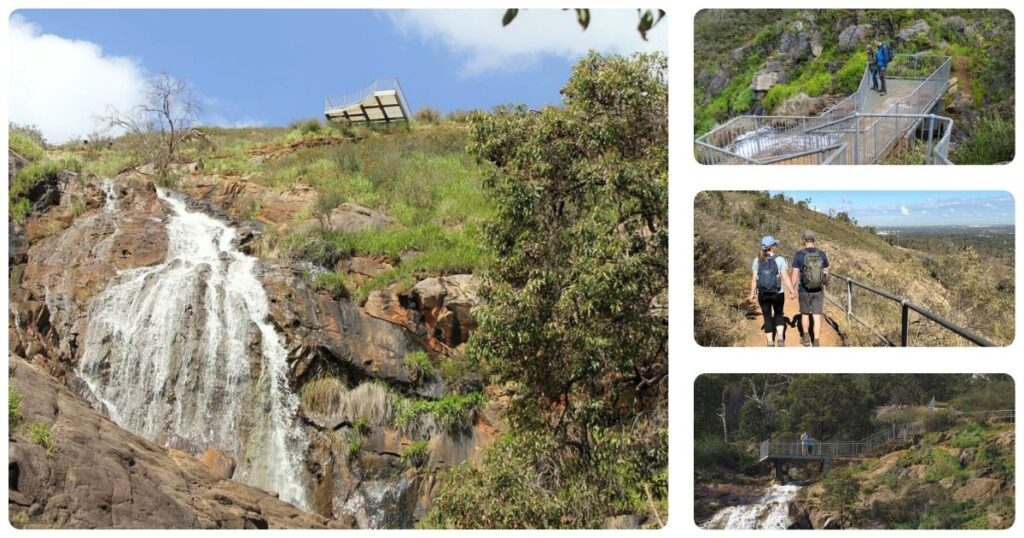
Lesmurdie Falls sits inside Mundy Regional Park on Whadjuk Noongar Country, about 23km east of the Perth CBD and a 25-minute drive. Entry is free, dogs are welcome on a leash, and the trails range from a 30-minute paved stroll to a two-hour loop through the valley below. The real surprise is the view as the falls sit on the edge of the escarpment, so the lookout gives you the water on one side and the whole Swan Coastal Plain rolling west toward the coast on the other.
| Known For | 50m waterfall off the Darling Scarp, escarpment views to the coast |
| Entry | Free, dawn to dusk |
| Best For | Families, casual walkers, photographers, day-trippers |
| Time Needed | 30 minutes (Falls Trail) to 2 hours (Valley Loop Trail) |
| Best Season | June–September (peak flow plus spring wildflowers) |
| Distance from CBD | ~23km east, 25-minute drive |
| Facilities | Free car parks, toilets, picnic tables (no water, no cafe) |
| Dogs | Welcome, on-leash at all times |
| Swimming | No (cold year-round, deep pool, unpredictable currents) |
Who It Suits
Families do well here. The Falls Trail is short, paved at the start, and suits kids from about age five, and the Foot of the Falls Trail adds a longer, brook-side option for anyone who wants more without a real climb. Photographers get reward from the elevated lookout and the soft morning light. Keen walkers can string the Shoulder and Valley Loop trails together into a proper half-day on the scarp. Dog owners do well too, leashed dogs are welcome on every trail.
It suits you less if you’re after a swimming hole. The pool below the falls is cold year-round, deep, and prone to unpredictable currents after rain, so it’s a look-don’t-touch waterfall.
The Falls and the Trails
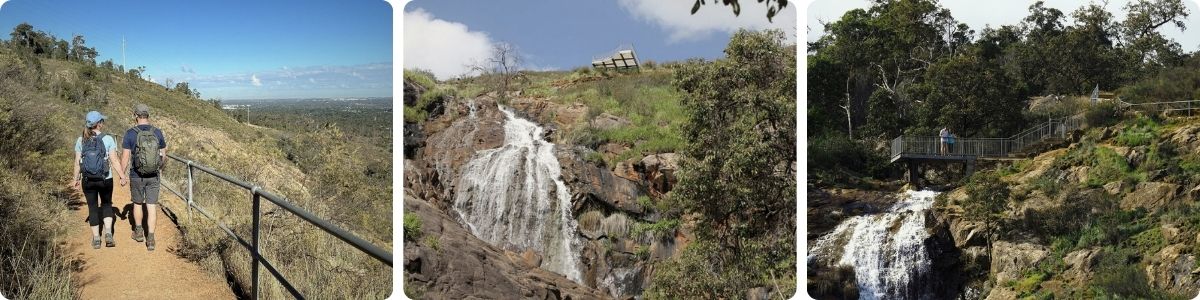
Lesmurdie Brook pours over the edge of the Darling Scarp in a single 50m drop, one of the few waterfalls in the Perth Hills you can actually see from a walking trail. From the main lookout you get the full height of it, ferns in the foreground, and that wide western view across the plain that most first-timers don’t expect from a bush waterfall.
There are two car parks and five trails, and you’ll get more out of the visit if you pick before you arrive rather than wandering the car park deciding. The Falls Road car park sits at the top, closest to the main lookout. The Weir car park at the end of Palm Terrace Road sits lower down and starts the walk to the base of the falls. Locals tend to prefer the lower car park: it’s quieter, and you get the view building as you climb rather than starting at the top and working down.
- Falls Trail: 640m return, about 30 minutes, Class 2 (easy), ages 5+. Paved start, no water crossing, leads to the elevated lookout over the full 50m drop. The most popular option and the one to do if you only do one.
- Cascade Trail: 300m return, about 30 minutes, Class 3, ages 6+. Short detour to a series of smaller cascades above the main falls, easy to add on to the Falls Trail.
- Shoulder Trail: 1.5km return, about an hour, Class 3 (moderate), ages 8+. Steeper with some rock scrambling, rewarded with a second angle on the falls.
- Foot of the Falls Trail: 2km return, about an hour, Class 3, ages 8+. Follows the brook down to the base of the falls from the lower car park. Keep an eye out here, walkers regularly spot splendid fairywrens and black-headed monitor lizards along this stretch.
- Valley Loop Trail: 3km return, about 2 hours, Class 3, ages 10+. The full circuit, taking in the falls, the brook and the surrounding bushland. The pick if you want the whole park rather than just the headline view.
If you want more distance again, the Whistlepipe Gully trail sits further into Mundy Regional Park proper (not part of the falls circuit itself) and passes the rambling ruins of a 1960s Japanese-style house built by a local architect, complete with an old water wheel.
Seasonal Timing (Read This First)
This is the part most people forget to consider. As you’d imagine, the falls are seasonal, fed by rainfall, and the right month makes difference between a good visit and a dull one.
- June–August (winter): Peak flow, the full 50m at its loudest. Temps 12–18°C, trails muddy and wet. The best window for the waterfall itself.
- September (spring): Tail-end flow plus strong early-spring rain, and the wildflowers arrive: Black Kangaroo Paw, everlastings, orchids, native daisies. Temps 15–22°C. The best overall window if you want water, flowers and decent weather together.
- October–November (late spring): Flow drops off fast and may dry by November. Pleasant walking weather, lighter falls.
- December–February (summer): Falls often run dry. Hot, 28–35°C, so start early or skip it for the waterfall. Fine as a bushwalk, disappointing as a waterfall trip.
- March–May (autumn): Variable flow depending on rain, mild 18–26°C, fewer people about.
What Locals Know
The biggest local tip is the one we already mentioned above, time it for winter or early spring or you’ll be photographing rock, go on the right month and you’ll have the beautiful waterfall you were expecting. Beyond that, park at the lower Weir car park on Palm Terrace Road rather than the upper Falls Road car park if you can. It’s quieter, and both car parks fill up by mid-morning on winter and spring weekends, so aim to arrive before 9am if a Saturday or Sunday is your only option.
Most first-timers do only the 30-minute Falls Trail and wish afterwards they’d allowed time for a second trail, so build in 90 minutes to two hours rather than treating it as a quick stop. Flies are a nuisance around the water in warmer months, so pack repellent, and there’s very little shade on most trails, so sunscreen, long sleeves and a hat matters more than the short walking times suggest. The trails near the base of the falls also get muddy, with loose gravel and tree roots that catch out anyone in regular sneakers rather than proper grip. On a busy Saturday you’ll sometimes find a mobile coffee van or sausage sizzle set up at the Falls Road car park, though don’t count on it being there every week.
For photography, early morning (7–9am) gives soft light and mist off the water, and late afternoon (4–5:30pm) lights the escarpment gold. The classic shot is from the Falls Trail lookout with the full drop and ferns in frame. Slow shutter speeds of half a second to two seconds blur the water nicely, which means a tripod. Skip harsh midday light. Bring 2 litres of water per person too, because there’s none on site and no cafe to bail you out.
Frequently Asked Questions
When is the best time to visit Lesmurdie Falls?
June to September. Winter (June–August) brings the strongest water flow over the full 50m drop, while September adds spring wildflowers and milder weather, making it the best all-round window. Avoid summer (December–February), when the falls often run dry and temperatures climb into the mid-30s.
How long does the walk take?
The most popular Falls Trail is 640m return and takes about 30 minutes at an easy pace. Most visitors find that’s not quite enough, so allow 90 minutes to two hours if you want to add the Cascade Trail or Foot of the Falls Trail and actually enjoy the views rather than rushing back to the car.
Can you swim at Lesmurdie Falls?
No. The pool below the falls is cold year-round, deep, and has unpredictable currents after rain. It’s a viewing waterfall, not a swimming spot. For a Perth Hills swimming hole, head to Serpentine Falls instead.
Is Lesmurdie Falls suitable for kids?
Yes, on the easier trails. The Falls Trail suits children from about age five and the Cascade Trail suits ages six and up. Keep younger kids close at the lookouts, since the escarpment edges are unfenced in places, and skip the steeper Shoulder and Valley Loop trails with little ones.
Are dogs allowed at Lesmurdie Falls?
Yes. Dogs are welcome on all trails as long as they’re kept on a leash at all times.
How do you get to Lesmurdie Falls without a car?
It’s possible but slow. Take the Airport line train to High Wycombe Station, then bus route 275 toward Canning Road, followed by a walk to the trailhead, roughly 1 hour 25 minutes door to door. There’s no bus running directly to the car park itself, so driving remains far quicker for most visitors. See our Perth public transport guide for planning the train and bus legs.
If the falls light a fire for waterfall chasing, Perth has a couple more worth the drive. Serpentine Falls down south gives you the swim Lesmurdie can’t, and Yanchep National Park to the north rounds out a weekend of easy nature day trips from the city.