
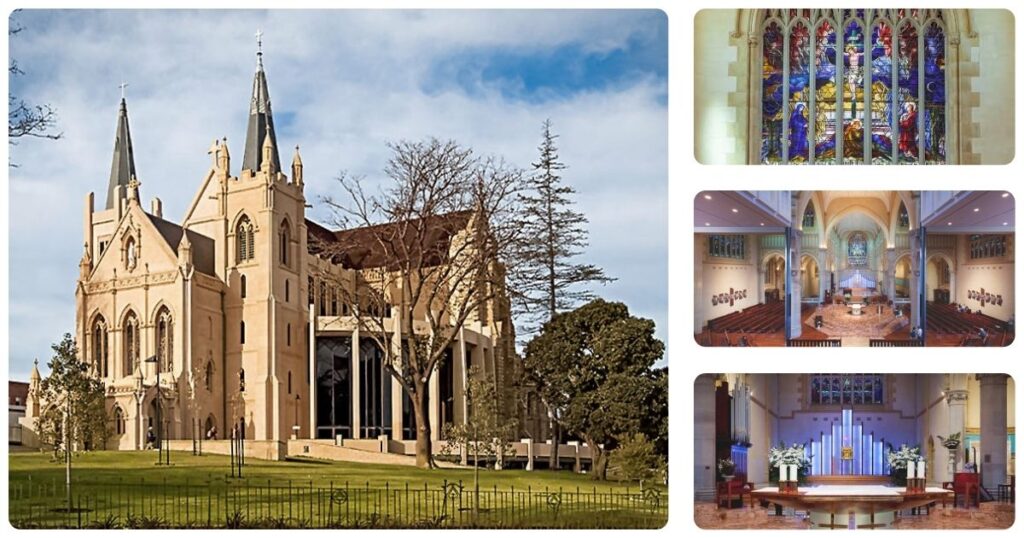
Walk into St Mary’s Cathedral and the light shifts first: stained glass throws colour across stone, the ceiling lifts away above you, and the nave stretches out further than the modest exterior on Victoria Square suggests it should. You’re standing in Perth’s Catholic cathedral, a building with a unusual history: part of it dates to 1865, part to a Depression-interrupted 1930 expansion left visibly unfinished for seven decades, and part to a $32.9 million rebuild completed only in 2009. Entry is free, and it sits at the centre of Perth’s cultural precinct, an easy add-on to a WA Museum or Art Gallery visit rather than a destination requiring its own trip.
Who It Suits
Architecture and heritage fans who want to see Gothic Revival stonework sitting directly against a 21st century glass and steel extension in the same building. Anyone building a cultural-precinct morning around the WA Museum and Victoria Square who wants a free, quiet 20 to 30 minute stop. Catholic visitors wanting to attend mass. It’s less suited to anyone chasing a purely “old” heritage experience, since more than half of what you’ll see today is 2006 to 2009 construction, not colonial-era stonework.
A Cathedral Built in Three Very Different Eras
The first St Mary’s opened on 29 January 1865, designed by Benedictine oblate Joseph Ascione in Norman Gothic style, its bricks made from clay dug at a property on Adelaide Terrace and its altar carved from marble donated by Benedictine monks in Rome. Money was so tight during construction that work stopped entirely in January 1864 for lack of funds.
In 1926, with the Catholic community outgrowing that original building, architect Michael Cavanagh designed a much larger Gothic replacement. The Great Depression hit before it could be finished: the new transept and sanctuary were built, but the money ran out, and the old 1865 building was simply kept on as the nave of the half-finished cathedral. Archbishop Patrick Clune said at the 1930 opening that completing the building would have to be “left to future generations.” It stayed that way, an awkward stitched-together amalgam in the words of a later archbishop, for the best part of 70 years, while damp and structural decay set in.
The final phase didn’t happen until 2006 to 2009. The cathedral closed entirely in August 2006, its bell tower crumbling and its foundations suffering from rising damp, for a rebuild that ended up costing $32.9 million against an original much smaller budget. Perth architect Peter M. Quinn designed a new nave and a second spire (deliberately not a copy of the original, at the Heritage Council’s insistence), added an underground parish centre, improved disabled access, and lifted seating capacity to around 1,600. During construction, workers found the remains of Perth’s earliest bishops beneath the aisle floorboards; a permanent crypt was built for them under the altar, and Perth’s first bishop, John Brady, was exhumed from his grave in France in 2011 and reinterred there. The rebuilt cathedral reopened on 8 December 2009 in a ceremony attended by Cardinal George Pell and more than 30 bishops, and went on to win three WA architecture awards, including the state’s heritage award.
That history is worth knowing before you walk in, because it explains what you’re actually looking at: a 1865 nave grafted onto a 2009 sanctuary and second spire, rather than a single continuous Gothic building.
What to See Inside
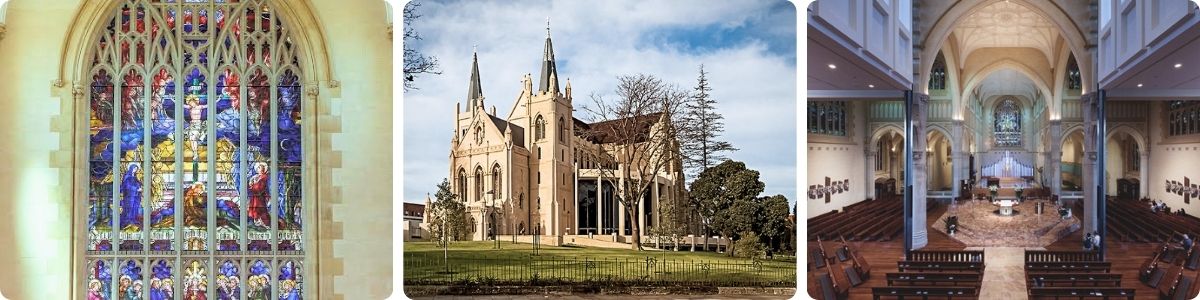
The stained glass in the older, 1930s section was designed and made in Birmingham, England, by John Hardman and Co, a firm that produced windows for cathedrals across the English-speaking world; look for how the light through these older windows differs in tone from the clearer glass in Quinn’s 2009 extension. The sanctuary mosaics were modelled on the illuminated designs of the Book of Kells. The original 1865 marble altar, donated from Rome, was relocated into the expanded sanctuary and remains the ceremonial centre of the cathedral. Side chapels off the main nave offer quieter spaces for private prayer, and the crypt beneath the altar holds the remains of Perth’s early bishops, a detail most visitors walk straight past without knowing it’s there.
Practical Details
Entry is free. Cathedral opening hours run roughly 6:30am to 6:30pm on weekdays and slightly later on weekends, though these shift around public holidays and cathedral events, so it’s worth checking saintmarys.au or calling +61 8 9223 1145 before you go if timing matters. Weekday mass is typically held around midday and again in the late afternoon, with additional Saturday and Sunday masses; confirm current times on the cathedral website rather than relying on any fixed schedule here, since these are adjusted periodically. Photography is generally fine for personal use outside of active services; skip the flash and be discreet during mass. Covered shoulders and knees are the general expectation for dress, nothing more formal than that. The cathedral has accessible entry and improved disabled access as part of the 2009 rebuild, including four accessible parking bays at the same level as the entrance; call ahead if you have specific mobility needs.
Allow 15 to 30 minutes for a general walk-through, or up to an hour if you’re photographing the architecture in detail.
Getting There
The cathedral sits right on Victoria Square at the northern end of Victoria Avenue, deep in the CBD and Perth Cultural Centre precinct. The free Red CAT bus stops directly in front, making it one of the easiest attractions in the city to reach without a car, and Perth Train Station is a short walk away for any Transperth line. If you’re driving, the cathedral’s own on-site parking is limited and free, with City of Perth Parking’s Fire Station Car Park (1 Murray Street) and the Hay Street and Pier Street Car Park (87–89 Pier Street) both close by as fallback options, though street parking nearby is limited.
What’s Nearby
St Mary’s sits right at the edge of Perth’s cultural precinct. The WA Museum Boola Bardip is a short walk away and pairs naturally with a cathedral visit for a cultural morning. The State Buildings heritage precinct is also within easy walking distance if you want another dose of restored 19th century Perth architecture alongside St Mary’s own old-and-new contrast. Victoria Square itself, directly in front of the cathedral, is a pleasant spot to sit afterwards, and Northbridge’s restaurants and bars are a 10 to 15 minute walk if you’re making an afternoon of it.
What Locals Know
Perth Catholics will tell you the cathedral’s two-tone character, old stone nave against the pale new sanctuary and second spire, still divides opinion two decades on; some locals find the contrast jarring, others consider it one of the more honest examples of heritage architecture in the city, since it doesn’t pretend the 2009 work is something it isn’t. The crypt beneath the altar is one of the least-known features even among regular Perth visitors, worth a mention if you’re showing someone around. Because the cathedral is an active parish rather than a museum, the quietest, least disrupted time to visit for architecture or photography is a weekday mid-morning outside the midday mass window; turning up right on midday on a weekday without checking mass times is the most common way visitors accidentally walk into a service already underway.
Is It Worth It?
Yes, particularly as a free add-on rather than a dedicated trip. On its own merits it’s a solid but not extraordinary heritage building; what makes it interesting is the unusual construction history, a cathedral built across three separate centuries with a 70-year gap in the middle, and its position inside Perth’s walkable cultural precinct. Combine it with the WA Museum or State Buildings rather than making a special trip just for St Mary’s alone.
Frequently Asked Questions
Is entry really free?
Yes, with no admission charge, though donations toward the cathedral’s upkeep are welcomed.
What are the visiting hours?
Roughly 6:30am to 6:30pm on weekdays, slightly later on weekends, though hours shift around events and public holidays. Confirm on saintmarys.au before visiting.
Can I visit during mass?
You can, but that time and space is set aside for worshippers. If you’re visiting purely as a heritage tourist, plan around the midday and late-afternoon weekday mass windows.
What if I’m not Catholic?
Everyone is welcome to view the building as a heritage and cultural landmark. Respectful behaviour around the active religious function is all that’s expected.
Is the whole building actually old?
No, and this is the most interesting thing about it. The original nave dates to 1865, but the sanctuary, second spire, underground parish centre and much of what you see today was built between 2006 and 2009 after the cathedral stood unfinished for 70 years.
How long should I spend here?
15 to 30 minutes for a general visit, up to an hour if you’re interested in the architecture or photography.
How do I get there without a car?
The free Red CAT bus stops directly outside on Victoria Square, and Perth Train Station, served by every Transperth line, is a short walk away.
Should I combine this with other attractions?
Yes. The WA Museum Boola Bardip and the State Buildings precinct are both close by, and Victoria Square out front is a good spot to sit afterwards.
The Close
St Mary’s Cathedral isn’t trying to be Perth’s biggest attraction, and it doesn’t need to be. It’s free, it’s five to ten minutes from the WA Museum and State Buildings, and the story behind the building, an 1865 nave stitched to a 2009 sanctuary after seven decades left unfinished, is more interesting than most visitors realise walking in. Give it half an hour, look for the crypt beneath the altar, and check mass times before you plan around midday.