
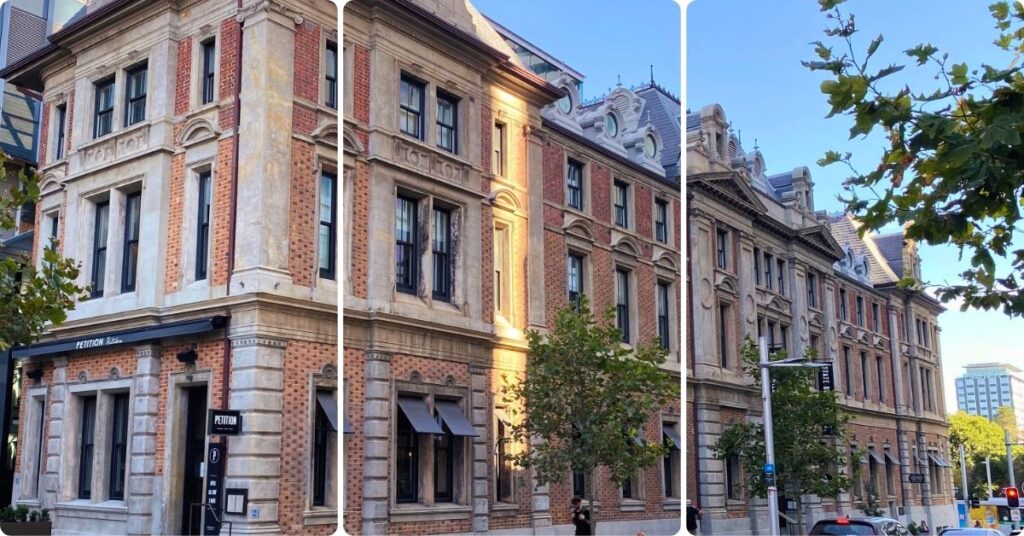
State Buildings Perth: Where Heritage Meets Haute Cuisine
Three heritage buildings. One perfect afternoon. No timeline pressure.
This is State Buildings, the seven-hectare precinct at St Georges Terrace and Barrack Street that has quietly become Perth’s most compelling destination for people who take dining, architecture, and history seriously. You’ll walk through a courtyard designed the way courtyards should be designed: open, unhurried, with enough character to make you stop and look around.
The buildings date from 1874. The State Treasury building, the architectural centrepiece of the group, was restored from a government office to a luxury hotel. The Lands and Titles buildings became fine dining venues, galleries, and retail spaces. The whole precinct is known locally as Perth’s Point Zero, the heart of the CBD where heritage and contemporary hospitality collide.
Most visitors treat State Buildings like a restaurant reservation. Some grab a drink at the Treasury bar. A few actually stop to look at the 1874 stonework, the heritage brass, the way these buildings have been restored to be functional rather than frozen.
This guide fills that gap.
What State Buildings Actually Is
State Buildings isn’t a single building. It’s a three-building heritage precinct that forms a unified courtyard space. Architecture-wise, it’s worth noting: the restoration work is scholarly. The buildings don’t feel like a mall theme-park version of heritage. They feel like the 150-year-old buildings that they genuinely are, that have been repurposed with intelligence and restraint.
You’re here for three reasons: the restaurants (award-winning), the hotel (luxury class), and the architecture (genuine heritage). The fourth reason, and the one that most miss, is to spend an hour in the courtyard with a coffee and no particular destination at all.
The Buildings Themselves
The State Treasury building is the main architectural statement. Constructed in the 1870s as the seat of Western Australian government finance, it’s built in Victorian-era stone with high ceilings, public galleries, and the kind of spatial grace that early government buildings were designed to convey. Modern visitors aren’t usually thinking about the building’s original purpose, but the spatial memory is there: confidence, solidity, gravitas.
The Lands and Titles buildings are quieter in appearance but equal in heritage significance. Together, the three form a precinct that manages to be both grand (in scale and materials) and intimate (in courtyard proportions and human-scaled details).
The Courtyard is the Payoff
Open, with seating, water features, and enough architectural enclosure to feel sheltered without feeling closed. This is where you discover what State Buildings actually is: not a dining destination with buildings attached, but a civic precinct that happens to contain restaurants.
The Restaurants: Where You Actually Spend Your Time
State Buildings is home to four (five in reality) incredible dining venues.
Post
Post is the fine dining flagship. Located in COMO The Treasury, Post operates at the level of fine dining that Perth doesn’t have many of. Modern Australian cuisine, technically precise, locally focused. The dining room is elegant without being pretentious — high ceilings from the original Treasury building, modern open kitchen, the kind of service that respects your time. Award-winning (multiple times). Not a casual venue, and not inexpensive, but if you’re spending an evening at State Buildings, this is the destination. Reserve in advance.
Petition
Petition is the contemporary option. Fresh local produce, casual plating, the kind of restaurant that could exist anywhere but is planted here with a specific commitment to quality. Good for lunch, good for a single course and a wine, good for the kind of meal where you’re not locked into a two-hour commitment.
Cape Arid Rooms
Home to the famed afternoon tea, the ultimate refined indulgence. They also feature regular dining events.
Wildflower
A very special experience. The menu is based on the six seasons of the indigenous tribe that once held these lands. The dishes are the finest local foods sprinkled with native flora.
Long Chim
Our favorite, Long Chim, occupies the basement of one of the heritage buildings. Thai street food from an authority, David Thompson, who has serious credentials in Bangkok-style cooking. The setting is characterful: heritage cellar, stone arches, the kind of atmospheric dining that makes basements feel intentional rather than defensive. The food is bold, technically skilled, and genuinely Thai rather than “Thai for Perth.” Less formal than Post, more inventive than casual. Lunch or dinner, this is worth planning around.
The Beer Corner and Wine Merchant
They are part of Petition but both are worth noting separately. Wine Merchant has a serious, hand-picked wine selection, and Beer Corner has 20 unique beers on tap. If you’re going to sit in the courtyard with a drink before or after dining, this is the bar that matters.
The COMO The Treasury Hotel: Luxury in the Precinct
COMO The Treasury is a luxury hotel integrated into the State Buildings precinct. Five stars in the traditional sense: high-thread-count sheets, marble bathrooms, the kind of service protocol that makes you feel anticipated.
The point here isn’t luxury itself. The point is location. You’re staying in a restored 1874 government building. Walking to dinner in Post means walking through heritage corridors that were originally designed as offices of state finance. This is the rare hotel where the building itself is the attraction, not just a container for amenities.
The hotel has 48 rooms. Not a massive property. Boutique by modern standards. The dining venues are directly accessible, the courtyard is immediately outside, and the CBD is a five-minute walk in any direction.
If you’re visiting Perth for business or leisure and want a hotel that feels like place rather than generic luxury, this is the option. Room rates sit in the $250–400 range depending on season.
Visiting State Buildings: Practical Details
Getting There
State Buildings is on St Georges Terrace in the Perth CBD. By car, five minutes from anywhere in the CBD. By public transport: multiple bus routes serve St Georges Terrace (routes 111, 160, 177, 179, 935 all pass nearby). Elizabeth Quay train station is a seven-minute walk. By foot from Northbridge, Subiaco, or Kings Park: all walkable, 15–25 minute journeys.
Parking
Perth CBD parking is abundant and reasonably priced. Street parking exists. Paid car parks are within 100 metres. Not difficult.
When to Visit
Lunch is the most casual time to visit. Sit in the courtyard, grab a coffee, explore the buildings. Dinner is the main event and Post in particular draws a serious crowd. Weekday lunches are quieter. Weekends busier.
How Long to Spend Here
1–2 hours if you’re just visiting the courtyard and grabbing a drink or light meal. 3 hours for a proper lunch. 3–4 hours for a dinner at Post. Overnight if you’re staying at COMO The Treasury.
What to Do Before or After
Elizabeth Quay is 10 minutes walk for additional dining and riverside space. Kings Park is 20 minutes walk uphill or a five-minute bus ride. The Perth Mint is 15 minutes walk for a quick cultural stop. WA Museum Boola Bardip is also nearby.
Beyond the Restaurants: What State Buildings Means
State Buildings matters for a reason beyond the individual restaurants (though they’re genuinely good). It matters because it’s proof that heritage precinct restoration can work if you’re patient and thoughtful about it.
The buildings aren’t a museum piece. They’re not a living history display. They’re working civic buildings repurposed as hospitality, retail, and leisure. This is how cities sustain themselves: by finding new uses for old buildings rather than demolishing and replacing.
You’re looking at what responsible heritage preservation looks like. And then you’re eating excellent Thai food in a 1874 basement, which is the point of the whole exercise.
Frequently Asked Questions
Is State Buildings free to visit?
Yes. The courtyard and precinct are entirely free to walk through. Individual restaurants and bars charge their own prices. The building interiors, where they’re accessible, are free to explore.
What’s the dress code?
Casual for the precinct, courtyard, and Petition. Smart casual for Long Chim. Smart casual or business attire for Post (can depend on the evening, call ahead if you’re unsure).
Do I need a reservation?
Highly recommended for dinner at Post and Long Chim on weekends. Petition is walk-in friendly. Call ahead or book online via the State Buildings website.
What about parking and transport?
Easy by either method. Paid parking is plentiful in the CBD. Public transport to St Georges Terrace is frequent (buses every 10–15 minutes).
Can I just visit the courtyard without eating?
Absolutely. Many people sit on the courtyard benches with coffee or a drink and no meal. This is entirely normal and encouraged.
What’s the best time to visit?
Lunch (11:30am–2:30pm) is casual and accessible. Dinner (5:30pm–late) is the main event. Weekdays are quieter. Weekends busier, particularly Friday and Saturday nights.
How does State Buildings compare to Elizabeth Quay?
Elizabeth Quay is larger, more precinct-like, more casual. State Buildings is smaller, more focused on dining and heritage, less about shopping. Both are worth visiting.
Are there vegetarian or dietary options?
Yes. Post, Long Chim, and Petition all accommodate vegetarian, vegan, and other dietary requirements. Ask when you book.
The Closing Note
You walk out of Post at 9:30pm on a Friday. The courtyard is lit up now, the heritage stone glowing amber under spotlights. The buildings feel different at night, less monumental, more intimate. You notice the craftsmanship in the original brickwork, the way the modern courtyard furniture sits against 1874 architecture. This contrast of old and new, heritage and contemporary, conservation and repurposing, is why State Buildings works.
It’s not a destination you’ll visit twice a year. It’s the kind of place you remember when someone asks, “Where should we go for something special?” And that’s enough.