
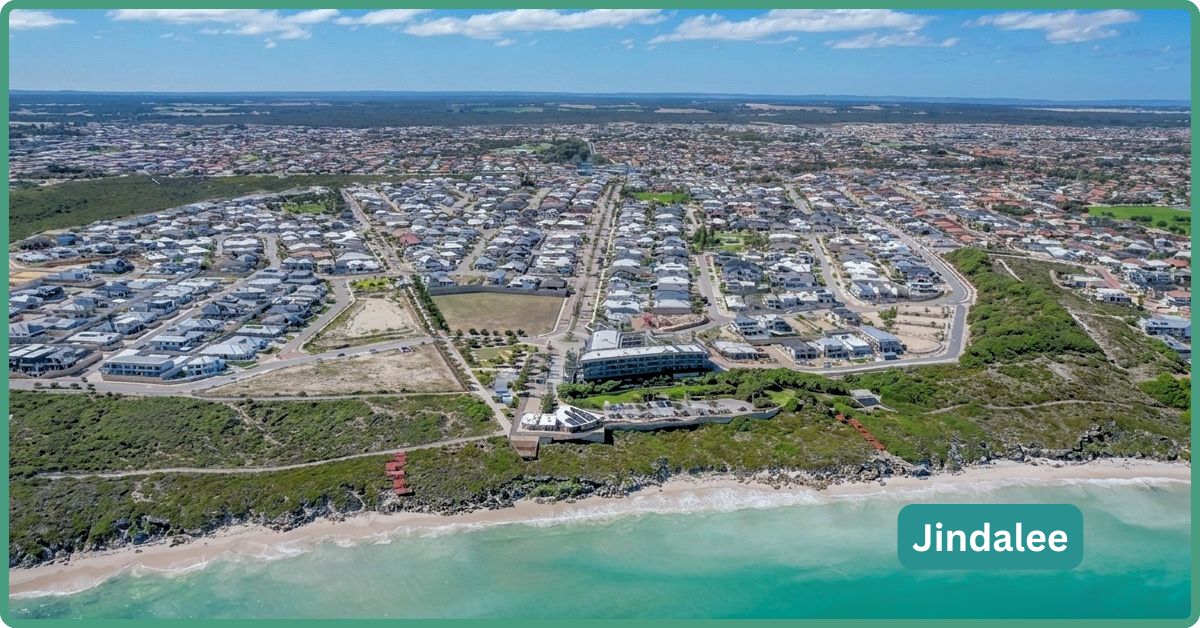
Jindalee had zero residents at the 2001 Census. By 2016 that number had climbed to 2,519, a rise of nearly 800 percent in the decade before, one of the more dramatic population arcs anywhere in the City of Wanneroo. The name itself was imported from an unknown New South Wales Aboriginal dialect meaning “a bare hill,” chosen by the old Shire of Wanneroo in 1979 and almost certainly referring to Eglinton Hill, decades before a single house existed here. Today Jindalee is a coastal suburb built around Satterley’s “Brighton Beachside” estate, with roughly 75 percent of its land still in its native bushland state, an unusually high proportion for a suburb this far along in its development.
Jindalee Suburb Map
Quick Facts
| Local Government Area | City of Wanneroo |
| Distance from Perth CBD | Approx. 40km north (36km per REIWA) |
| Postcode | 6036 |
| Population | 2,519 (2016 Census, Wikipedia); REIWA reports the same 2,519 figure |
| Median House Price | $1,150,000 |
| Annual Growth | 28.8 percent (sales) |
| Known For | Aboriginal word for “a bare hill”; Satterley’s Brighton Beachside coastal estate; 75 percent still native bushland |
| Coastline | Fronts the Indian Ocean along its western boundary |
Who It Suits Presently
Jindalee suits buyers chasing a genuine beachfront or near-beachfront lifestyle in Perth’s northern corridor, particularly those wanting large, mostly untouched coastal bushland on their doorstep alongside a still-developing residential estate. It’s a strong fit for buyers comfortable with a suburb that’s still filling in, with basic rather than extensive local amenity. It’s a less natural fit for buyers wanting an established town centre, since Jindalee still relies heavily on neighbouring Butler for shops, schools and services.
Named for a Bare Hill, Built on Brighton Beachside
The name Jindalee was proposed by the old Shire of Wanneroo on 29 June 1979, decades before any development occurred here. It’s an imported Aboriginal word from an unknown New South Wales dialect meaning “a bare hill,” most likely referring to Eglinton Hill, a low, sparsely vegetated rise within the suburb. The same word was applied to another Jindalee in south-western Brisbane in 1964, and both suburbs share the same word origin despite being on opposite sides of the country.
Planning for the suburb goes back to 1997, with the Butler-Jindalee District Structure Plan formally approved by the Western Australian Planning Commission on 18 November 2003. Satterley has managed the development, marketed under the name “Brighton Beachside,” in conjunction with the Department of Housing and Works, with around 900 residential lots proposed across the estate. Jindalee had a nil population at the 2001 Census, but the 2006 Census recorded 145 residents, rising to an estimated 1,274 by 2011 and 2,519 by 2016, a trajectory of growth almost unmatched elsewhere in the City of Wanneroo over that period.
Even with that growth, Jindalee remains unusually undeveloped by Perth suburb standards, with approximately 75 percent of its land area still within its native bushland state as of the most recent detailed survey. That undeveloped land, bounded by an east-west line near Eglinton Rocks to the north, Marmion Avenue and neighbouring Butler to the east, and Hampshire Drive and Quinns Rocks to the south, gives Jindalee a genuinely different character to the more built-out suburbs immediately inland.
Attractions and Things to Do
Eglinton Hill is Jindalee’s standout natural feature, offering views over the ocean and the scrubland stretching north towards Eglinton and Yanchep. The suburb’s largely untouched beaches, accessible via sand tracks, run almost continuously up the coast, giving residents and visitors a genuinely wild stretch of coastline uncommon this close to established Perth suburbs.
The undeveloped bushland itself, covering roughly three-quarters of the suburb, supports Xanthorrhoea preissii, banksia, sheoak and Nuytsia floribunda.
Life in Jindalee Day to Day
Realty Market
REIWA data current to July 2026 puts Jindalee’s median house price at $1.15 million, up a very strong 28.8 percent over the past year, among the fastest growth rates recorded anywhere in this stretch of the City of Wanneroo. Three-bedroom houses carry a median of $910,000 and four-bedroom homes $1.2 million, with an upper quartile of $1.37 million and a lower quartile of $928,000. Houses typically sell within 18 days. Vacant land carries a median of $606,500, split between $355,000 for smaller blocks, $545,000 for medium blocks and $810,000 for larger blocks, reflecting the suburb’s continued release of new coastal land. Rentals are also strong, with prices up 6.7 percent over the year to a median of $800 a week; three-bedroom homes rent for a median of $725 a week and four-bedroom homes for $850, with houses taking a median of 14 days to lease and units 28 days.
Nearby suburb growth confirms the wider coastal corridor is performing exceptionally well: Butler grew 19.7 percent, Alkimos grew 18.1 percent and Quinns Rocks grew 13.6 percent over the past year, all solid figures but each trailing Jindalee’s own standout 28.8 percent, underlining just how strong recent demand has been for this particular pocket of coastline.
Hospitals and Healthcare Nearby
Jindalee itself has a single medical centre on Jindalee Boulevard, but residents needing broader healthcare rely on nearby Butler, Clarkson or Joondalup for GP clinics, pharmacies and hospital care. Joondalup Health Campus remains the closest major public hospital, a reasonable drive south along Marmion Avenue and Mitchell Freeway.
Schools and Education
Jindalee has no school within its own boundaries, but Butler Primary School, a government school, sits just 0.7 kilometres from the suburb’s centre, and Quinns Beach Primary School, also government, is 0.9 kilometres away, giving local families two genuinely close primary options despite neither being technically inside Jindalee. Butler College, a government secondary school, is 1.2 kilometres away, giving the suburb reasonable access to a full run of schooling without residents needing to travel far, even though every option sits just across the suburb boundary in Butler.
Industry and Work Life
Jindalee remains overwhelmingly residential and undeveloped, with essentially no local employment base of its own beyond the medical centre and a fish and chips shop on the foreshore. Most working residents commute to Butler, Clarkson, Joondalup or further into Perth, supported by nearby Butler and Clarkson train stations and the Mitchell Freeway corridor. Brighton Village Shopping Centre, sitting on the suburb’s eastern border in neighbouring Butler, provides the closest significant retail and service employment.
Parks and Greenspaces
With roughly three-quarters of Jindalee still in its native state, the suburb’s greenspace is dominated less by formal parks than by genuine, largely untouched coastal bushland, heath and woodland stretching from Eglinton Hill north towards Eglinton and Yanchep. That undeveloped land supports a real diversity of native flora, including Xanthorrhoea preissii, banksia, sheoak and Nuytsia floribunda, though sections have suffered degradation from uncontrolled trail bike access and historical land uses. For buyers who value proximity to genuine bushland and beach over manicured suburban parks, Jindalee offers something increasingly rare this close to established Perth suburbs.
As the suburb develops, new parks are being created that so far include Marlinspike Park with a playground and kickabout space. Eden Beach Foreshore Park is the almost sole development on the foreshore (not for long) with green space, seating, BBQ’s, parking, cafe, and easy beach access.
Transport
Jindalee has no train station of its own, but Butler and Clarkson stations on the Yanchep line sit close enough to serve the suburb via connecting bus routes. Transperth routes 481 and 482 run between Butler and Clarkson stations serving Marmion Avenue, Roundhouse Parade, Jindalee Boulevard and Santa Barbara Parade, while route 486 runs between Butler and Alkimos stations along Marmion Avenue.
Marmion Avenue itself forms the suburb’s eastern boundary and its main arterial connection to the wider northern suburbs road network.
What Locals Know
Locals know the beaches accessible via sand tracks north of the developed estate are some of the least crowded anywhere in Perth’s northern suburbs, a genuine drawcard for anyone wanting space on the sand without a long drive further north. They know the suburb’s bushland, while beautiful, has visible scarring from uncontrolled trail bike use in places, worth seeing for yourself before assuming every corner is pristine. And they know that despite Jindalee’s own modest amenity, Brighton Village Shopping Centre just across the border in Butler covers day-to-day needs well enough that most residents rarely feel the gap.
Trade-Offs to Weigh
Jindalee’s strengths are its genuine coastal position, its unusually high proportion of untouched native bushland, and standout recent price growth well ahead of its immediate neighbours. Its trade-off is a still-thin local amenity base, with no shops beyond a single fish and chips outlet and medical centre, no school within its own boundaries, and no train station, leaving residents reliant on neighbouring Butler for almost everything beyond housing itself. Buyers should also weigh the suburb’s history of rapid, still-ongoing development, meaning parts of Jindalee will likely continue to feel like a construction zone for some years yet. For buyers prioritising a genuine coastal and bushland lifestyle over established local amenity, Jindalee remains one of the more distinctive options in the northern corridor.
The Honest Verdict
Jindalee has gone from a nil population in 2001 to a genuinely thriving coastal market today, its name drawn from a bare hill on the far side of the country and its character shaped as much by untouched bushland as by its Brighton Beachside housing estate. With sales growth of 28.8 percent over the past year and a median of $1.15 million, Jindalee suits buyers who want real coastal access and don’t mind a suburb that’s still filling in around them, relying on neighbouring Butler for the schools, shops and train station this suburb doesn’t yet have of its own.
Frequently Asked Questions
Why is Jindalee called Jindalee?
The name is an imported Aboriginal word from an unknown New South Wales dialect meaning “a bare hill,” proposed by the Shire of Wanneroo in 1979 and most likely referring to Eglinton Hill.
What is the median house price in Jindalee?
REIWA data current to July 2026 puts the median at $1.15 million, up 28.8 percent over the past year.
Does Jindalee have a train station?
No, but Butler and Clarkson stations on the Yanchep line are both accessible via Transperth bus routes 481, 482 and 486 running through the suburb.
Does Jindalee have shops and schools?
Jindalee has a medical centre and a fish and chips shop but no school or major shopping centre of its own. Brighton Village Shopping Centre and Butler Primary School, Quinns Beach Primary School and Butler College all sit just across the border in neighbouring Butler.
References
Australian Bureau of Statistics (abs.gov.au) Census SAL data for Jindalee. Local government context confirmed via the City of Wanneroo website. For nearby suburb profiles in this series, see the Eglinton Profile and the Alkimos Profile.