
Eglinton takes its name from a shipwreck, just like its southern neighbour Alkimos. The barque Eglinton foundered on rocks near what’s now the Alkimos coastline, and when the suburb was formally gazetted in 1974, its name was drawn straight from the wreck. Long before any of that, the Mooro people of the Noongar nation had lived across this stretch of the Swan Coastal Plain for more than 40,000 years, and local legend traces Pipidinny Swamp, in eastern Eglinton, to the blood and meat of a crocodile’s tail as it made its way back to the Swan River after a mythical fight with a shark. Today Eglinton is one of the fastest-growing suburbs anywhere in Perth, its population having more than doubled in the five years to the 2021 Census.
Eglinton Boundary Map
Quick Facts
| Local Government Area | City of Wanneroo |
| Distance from Perth CBD | Approx. 44km north |
| Postcode | 6034 |
| Population | 3,705 (2021 Census) |
| Median House Price | $828,000 |
| Annual Growth | 16.6 percent (sales); 4.6 percent (rental) |
| Known For | Named after the wrecked barque Eglinton; part of the Alkimos-Eglinton satellite city plan; Eglinton railway station |
| Land Area | 10km² |
Who It Suits
Eglinton suits buyers and renters wanting brand-new coastal housing at a genuinely accessible price point, with train access already in place ahead of most of the surrounding infrastructure. It’s a strong fit for young families and first-home buyers drawn to new-build estates and a relaxed coastal lifestyle who don’t mind being on the leading edge of a still-developing area. It’s a less natural fit for buyers wanting established streets, mature gardens, or a wide choice of local shops and services, since much of Eglinton remains under active construction and its promised town centre has yet to be built.
Named for a Shipwreck, Built as Half a Satellite City
Eglinton’s name goes back to the barque Eglinton, wrecked on rocks near what’s now the neighbouring suburb of Alkimos, a piece of maritime history the two suburbs effectively share. The name was formally approved in 1974, decades before any real development took place, and for most of the twentieth century the area remained largely untouched, covered in native banksia woodland, scrubland and heath typical of the Swan Coastal Plain, including grasstree (Xanthorrhoea preissii), banksia, sheoak and Nuytsia floribunda. Some degradation occurred over the decades from uncontrolled vehicle access, stock grazing, fire and rabbits, but much of the original vegetation character survived largely intact into the 2000s.
Long before European settlement, the Mooro people of the Noongar nation lived across this part of the Swan Coastal Plain for more than 40,000 years, drawing on the abundant food and water around the chain of local wetlands. Local Noongar legend holds that Pipidinny Swamp, in eastern Eglinton, was formed from the blood and meat of a crocodile’s tail as the animal made its way back toward the Swan River following a mythical battle with a shark. In 1865, European settlers began using existing Aboriginal tracks along the western side of the lakes as a stock route between Dongara and Fremantle, a route whose Joondalup-to-Yanchep section was later formalised in 1988 as part of the Bicentennial Heritage Trails Network, now known as the Yaberoo Budjara Heritage Trail.
Modern development arrived in earnest from May 2006, when the state government revealed plans for the Alkimos-Eglinton satellite city, covered by Metropolitan Region Scheme Amendment 1029/33. LandCorp estimated the completed area would eventually house 55,000 residents, with hospitals, tertiary education, and major retail, commercial and recreational facilities. The Environmental Protection Authority raised concerns in November 2005 that the plan would be, in part, inconsistent with protecting the area’s significant environmental and geoheritage values, recommending a substantial increase in protected reserves. Development is now underway through the Amberton estate by Stockland and the Allara estate by Satterley, the latter one of only two estates in Western Australia to achieve a six-star energy rating.
Life in Eglinton Day to Day
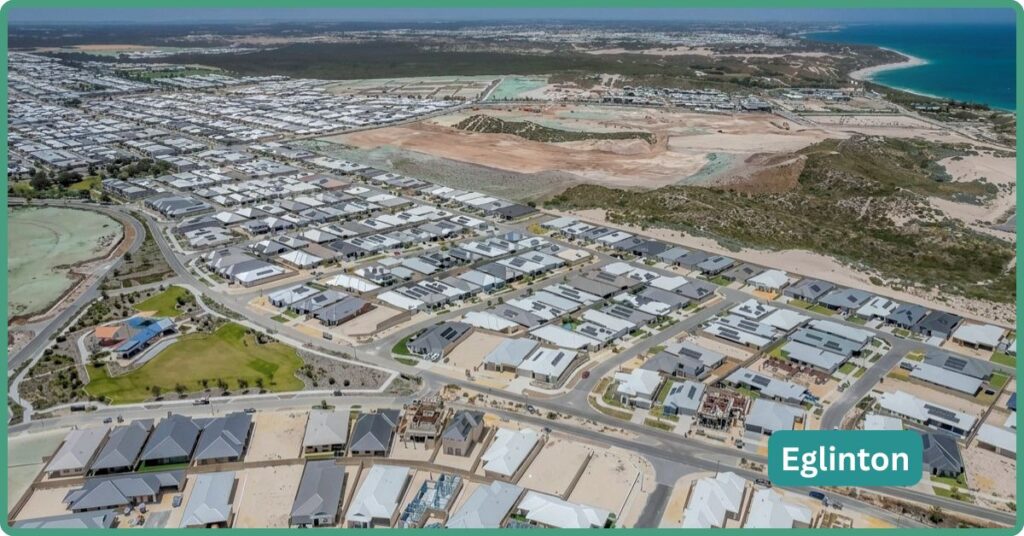
Eglinton’s coastline remains one of its biggest draws, with the wreck of the Eglinton visible from the shore near the Alkimos boundary and an almost untouched stretch of beach accessible via sand track, with a paved coastal road under construction. Eglinton has no conventional town centre facilities at this stage, a genuine gap the state’s satellite city plan is meant to eventually fill, but the Amberton and Allara estates are steadily filling in with houses built, more under construction, and many blocks already titled.
For daily needs, residents who’ve already moved in head to the newly opened Woolworths at the eastern side of Marmion Avenue. Otherwise, the nearest option is Butler Central, about 11 min by car, which is also anchored by a Woolworths and specialty retailers.
Realty Market
REIWA data current to July 2026 puts Eglinton’s median house price at $828,000, up a strong 16.6 percent over the past year, with rental growth of 4.6 percent taking median rent to $680 a week. Two-bedroom houses carry a median of $785,000, three-bedroom homes $751,000, and four-bedroom homes $861,000, with an upper quartile of $900,000 and a lower quartile of $758,000. Vacant land remains genuinely affordable at a median of $390,000, reflecting the suburb’s still-active development pipeline. Houses typically sell within 10 days, a fast turnaround for a suburb this new. It’s worth noting REIWA’s own population figure for Eglinton (1,680) reflects older 2016 data rather than the ABS 2021 Census count of 3,705, itself already well behind the suburb’s current population given how rapidly Eglinton has continued to grow since the census.
Nearby suburb growth confirms the wider corridor remains exceptionally strong: Alkimos grew 18.1 percent and Yanchep grew 16.0 percent over the past year, placing Eglinton’s own solid 16.6 percent squarely within this consistently hot stretch of Perth’s northern coastal fringe.
Hospitals and Healthcare Nearby
Eglinton does not yet have its own hospital, though Joondalup Health Campus is accessible by car, and the long-term Alkimos-Eglinton satellite city plan includes provision for a future hospital as the combined area’s population grows toward its projected 55,000. GP clinics and pharmacies are limited within Eglinton itself at this stage, with most residents currently relying on facilities in neighbouring Alkimos or further afield until the promised town centre eventuates.
Schools and Education
Northshore Christian Grammar School, a non-government combined school, sits 1.8 kilometres from the suburb’s centre. St James’ Anglican School, also non-government and combined, is 3.7 kilometres away, and Alkimos Beach Primary School, a government school, is 4.5 kilometres from the centre in neighbouring Alkimos. As Eglinton’s population continues its rapid growth, further dedicated schools within the suburb itself are likely to follow, mirroring the pattern already seen in Alkimos immediately to the south.
Industry and Work Life
Eglinton remains almost entirely residential and construction-driven at this stage, with significant local employment tied to the ongoing housing and infrastructure build-out across the wider Alkimos-Eglinton satellite city area. The next major wastewater treatment plant for the Perth metropolitan region has been built in the Eglinton area, designed to service catchment from Two Rocks south to the existing Beenyup treatment plant boundary, adding a genuine piece of regional infrastructure and associated jobs to the suburb. For commuters, Eglinton railway station and the Mitchell Freeway reserve to the east are steadily cutting travel times into the city as the surrounding road network matures.
Parks and Greenspaces
Eglinton’s native banksia woodland, scrubland and heath, though patchily degraded in places, still cover much of the suburb’s undeveloped land, offering genuine bushland character alongside its coastal frontage. Pipidinny Swamp, with its Noongar cultural significance, sits within eastern Eglinton, and the suburb’s near-untouched beach south of the Alkimos boundary gives residents ready access to a genuinely wild stretch of coastline rare this close to a fast-growing urban area.
Transport
Eglinton railway station, on the Yanchep line, gives the suburb direct Transperth rail access into the Perth CBD. Swan Transit buses connect the station to surrounding areas, including route 491 to Alkimos station via Marmion Avenue and Heath Avenue, route 492 also to Alkimos station via Marmion Avenue, and routes 494, 495 and 496 north to Yanchep station.
Marmion Avenue, extended through the suburb in 2008, is the main arterial road, while the future Mitchell Freeway reserve runs along Eglinton’s eastern edge, promising further improved road access as the corridor develops. Before 2008, Eglinton was accessible only via Pipidinny Road, which still runs through the suburb to within 200 metres of the beach.
What Locals Know
Locals know the Eglinton wreck and the surrounding coastline are genuinely worth the walk, one of the few stretches of near-untouched beach left this close to Perth’s growing northern suburbs. They know the promised town centre hasn’t arrived yet, and they know Eglinton, like its southern neighbour, is very much a suburb under construction, with new estates, roads and eventually a town centre expected to reshape the area substantially over the coming years along with foreshore development.
The foreshore development under the Alkimos-Eglinton structure plan envisages an Eglinton Marina and Coastal Village, with an EPA-approved marina of approximately 220 berths. The planning document explicitly describes the marina as a catalyst for tourism facilities and marine recreation businesses.
Trade-Offs to Weigh
Eglinton’s strengths are genuine coastal access, an already-operating train station, brand-new housing stock, and strong recent price growth from a still-accessible base. Its trade-off is a genuine lack of local amenity at this stage, with no proper town centre yet built and most shopping beyond daily needs requiring a trip to Alkimos or beyond, plus a distance of some 44 kilometres from the Perth CBD that keeps it firmly in outer-suburban territory. Buyers should also weigh the suburb’s still-active construction phase against more established coastal suburbs closer to the city. For buyers prioritising new-build value, direct rail access and long-term growth potential over immediate local amenity, Eglinton offers a genuinely compelling opportunity.
The Honest Verdict
Eglinton has gone from empty coastal bushland named after a shipwreck to one of Perth’s fastest-growing suburbs, its population more than doubling between the 2016 and 2021 censuses and continuing to climb since. With 16.6 percent sales growth over the past year, an already-operating train station, and a median still under $850,000, Eglinton is a genuinely compelling suburb for buyers willing to accept a still-developing local amenity base in exchange for new coastal housing and strong long-term growth potential.
Frequently Asked Questions
Why is Eglinton called Eglinton?
The suburb is named after the barque Eglinton, which wrecked on rocks near the modern Alkimos coastline. The name was formally approved in 1974.
What is the median house price in Eglinton?
REIWA data current to July 2026 puts the median at $828,000, up 16.6 percent over the past year, with median rent at $680 a week.
Does Eglinton have a train station?
Yes. Eglinton railway station, on the Yanchep line, provides direct rail access into the Perth CBD.
Does Eglinton have a town centre?
Not yet. Eglinton is part of the state government’s Alkimos-Eglinton satellite city plan, which includes a future town centre, but as of now the suburb has no conventional local shopping facilities.
References
Australian Bureau of Statistics (abs.gov.au) 2021 Census SAL data for Eglinton. Local government context confirmed via the City of Wanneroo website. For nearby suburb profiles in this series, see the Alkimos Profile and the Jindalee Profile.