
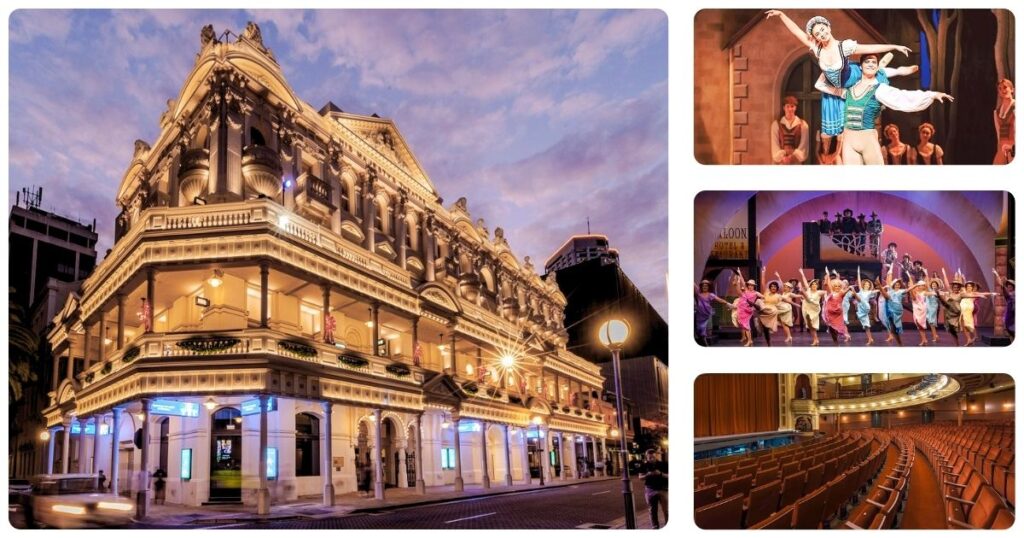
You’re standing in the foyer under a chandelier that’s been burning since 1904. The ceiling rises three storeys above you. Ornate plasterwork, a grand staircase with sweeping curves, burgundy velvet, mirrors reflecting gold leaf. This is His Majesty’s Theatre, locally called “The Maj”, and it’s widely regarded as the only working Edwardian Baroque theatre left in Australia. Opened on Christmas Eve 1904, it has been running performances every week since.
It was designed by architect William G. Wolfe and built by German contractor Friedrich Wilhelm Gustav Liebe, and it’s thought to be the first reinforced concrete building constructed in Perth. When it opened it was the largest theatre in Australia, seating over 2,500 people; the current capacity, after later renovations, is 1,263.
| Known For | Australia’s only working Edwardian Baroque theatre, opened 1904 |
| Home To | West Australian Ballet, West Australian Opera |
| Capacity | 1,263 (originally over 2,500) |
| Museum | Free, weekdays 10am–4pm, 40,000+ catalogued items |
| Location | 825 Hay Street, corner of Hay and King Streets, Perth CBD |
| Tours | Bookable, 60–90 minutes, groups up to 15 |
| Getting There | 5 to 6-minute walk from Perth Station, Red CAT stops outside |
Who It Suits
Heritage and architecture fans get genuine value even without attending a show, through the free museum and bookable backstage tour. Ballet and opera audiences get a heritage venue experience that purpose-built modern theatres can’t replicate: the intimacy, the acoustics, the sense of occasion. If you’re in Perth for a few days and enjoy live performance, checking what’s on here is worth the effort. It suits you less if you’re after a casual wander-in; unlike a museum, you can’t freely explore the auditorium or backstage without either a ticket to a show or a booked tour.
The Architecture
This is not subtle. The theatre was built at the height of Perth’s gold rush boom, when money was flowing and architecture was a statement. Edwardian Baroque means ornate, confident, unapologetic about decoration. The exterior is honey-coloured sandstone from the quarries that built much of Perth’s CBD. Inside: plasterwork, gilt, velvet and theatrical grandeur scaled for an era when going to the theatre meant dressing up and treating the evening as a public ritual.
The main auditorium retains its original horseshoe seating across three levels, each with private boxes, a social hierarchy built into the architecture itself. The proscenium arch frames the stage like a jewelled box, and the original gas lighting fixtures are still visible above the seating, though modern lighting has since been retrofitted. The sightlines were a genuine achievement for 1904: from almost every seat, you can see the stage without obstruction, at a time when most theatres had significant blind spots. The curved balconies also distribute sound evenly enough that performers don’t need to project hard to reach the back rows, one of the reasons the building is still in active use 120 years on.
Performances
His Majesty’s is the home venue for West Australian Ballet and West Australian Opera, both state-funded professional companies, alongside touring theatre, classical orchestras and international performers passing through on Australian circuits. Winter (June–August) is the busiest performance season; summer is lighter. Ticket prices vary widely by production and seating, roughly $30–150+. Check the Arts and Culture Trust website for what’s currently showing, and book 2–4 weeks ahead for popular productions.
Best Seats at His Majesty’s Theatre Perth
The Maj has been putting on shows since 1904, and the seating plan still carries some of that old theatre logic. The official plan lists Stalls (580 seats), Dress Circle (319) and Upper Circle (348), a total of 1,253 seats across the house.
Best overall – centre Stalls
Aim for the centre of the Stalls, roughly rows H to L. This is the safest pick if you want to sit close without losing sight of the whole stage. Favour the middle of the row over the far ends. A particularly good target sits around Stalls rows H to L, seats 14 to 23. The exact sweet spot shifts a little depending on the production. Note that stalls rows A, B and C are removed when the orchestra pit is in use.
My personal pick – centre Dress Circle
If closeness to the performers isn’t the priority, I’d seriously look at the Dress Circle, centre section, rows A to D. The elevated angle makes it easier to read the whole stage, the choreography, and the set design as one picture rather than a close-up. It’s also the seat that gives you the full grand-theatre feeling this building was built for. For a lot of productions, I’d take Dress Circle A to D, central seats, over a similarly priced Stalls seat without much hesitation.
Best value – front-centre Upper Circle
If price is the deciding factor, look at the front rows of the Upper Circle, centrally located.You’re further from the stage, no question. But the height compensates: a central Upper Circle seat gives a surprisingly complete view for the money, and I’d take one over a cheap seat shoved out to the side every time.
Seats to avoid
A few spots are worth steering around and they include the extreme side seats, because the curve of the auditorium has you looking across the stage instead of into it. Very rear Stalls, where you sit underneath the Dress Circle overhang and lose some of the elevated sightline. Side and box seating, which looks the part architecturally but can compromise the view. Very front Stalls, unless being close is the whole point, since looking up at the stage from there can flatten your sense of perspective.
Important: The official seating map also marks pillars and restricted-view areas, so the actual seat number matters more than the section name alone. Seating Plan PDF is available at Arts and Culture Trust seating plan.
Museum of Performing Arts
Inside the theatre, free entry, weekdays 10am–4pm, closed weekends and public holidays. Over 40,000 catalogued items: playbills from Perth’s earliest theatrical companies in the 1890s, photographs of opening nights, costumes from specific productions, and oral history recordings of former performers, ushers and patrons describing what it meant to attend theatre in Perth across different decades. Most visitors spend 30–45 minutes here. It’s not large, but it’s dense, run by volunteers and passion rather than major institutional funding, which is the honest reality of how a lot of regional cultural heritage survives in Australia.
Behind-the-Scenes Tours
Booked in advance, groups capped at 15, running 60–90 minutes. You get access to the heritage dressing rooms, the machinery behind the curtains and lighting, and the auditorium from the stage side, usually led by a retired theatre staff member or local historian who adds context you won’t get from the museum alone. Tours fill quickly during school holidays, so book ahead for a specific date via the box office. For availability enquire at the venue box office or call (08) 6212 9292.
Getting There and Eating Nearby
Perth Train Station is a 5 to 6-minute walk, Elizabeth Quay Station about 10 minutes, and the free Red CAT bus has a stop right outside called “His Majesty’s” on Hay Street.
If you’re driving, undercover parking is available close by at His Majesty’s Carpark (City of Perth Carpark No.5, entry from Murray Street) and Kings Parking (entry from King Street), plus general street parking and commercial car parks nearby running roughly $6–12 a day; if you’re attending an evening show, public transport is easier than fighting for a park.
Crew & King Café in the foyer opens two hours before performances for pre-show food and coffee. The Museum Bar opens an hour before shows through interval. Beyond the theatre, Hay Street’s retail and dining strip is a 2-minute walk, and Elizabeth Quay’s waterfront restaurants are about 10 minutes on foot.
Frequently Asked Questions
Can I just walk in and look around?
You can enter the free foyer to see posters and book tickets, but the auditorium and backstage are only accessible via a performance ticket or a booked tour.
How much are tickets?
Roughly $30–150+, depending on the production and seating. Check the Arts and Culture Trust website for current shows and pricing.
Is the theatre wheelchair accessible?
Yes, with wheelchair access, accessible restrooms and staff assistance available. Some seating is limited due to the heritage building. Contact the box office on (08) 9265 0904 for specifics.
What’s the Museum of Performing Arts, and is it worth visiting on its own?
A free, volunteer-run archive of over 40,000 items covering 120+ years of Perth theatrical history, open weekdays 10am–4pm. Worth 30–45 minutes even if you’re not seeing a show.
How close is it to other Perth attractions?
Elizabeth Quay is a 10-minute walk, Kings Park 15–20 minutes via the river path, and Perth Train Station 5 to 6 minutes.
How do I get there without a car?
The free Red CAT bus stops right outside on Hay Street, and Perth Train Station, served by every Transperth line, is a 5 to 6-minute walk.
If heritage architecture is your thing, the State Buildings a few minutes’ walk away make a natural pairing, and Elizabeth Quay rounds out a CBD heritage-and-waterfront afternoon.