
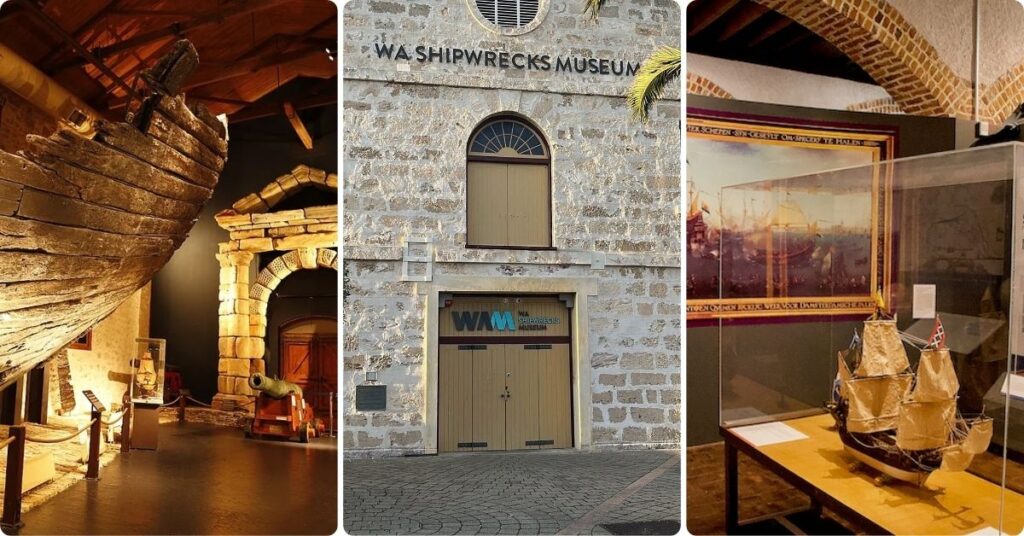
WA Shipwrecks Museum Fremantle: The Batavia at Your Feet, Four Centuries of Stories
You’re standing in front of the reconstructed stern of a ship that wrecked 60 kilometres off the Western Australian coast in 1629. The ship was the Batavia, a flagship of the Dutch East India Company (VOC). It went down on Morning Reef, and what happened after—the mutiny, the murders on the Abrolhos Islands, the survival and rescue—became one of the most extraordinary shipwreck narratives in European colonial history.
This is not a model or a replica. These are the original timber remains, excavated from the seabed in the 1970s, restored over decades, and reassembled in a heritage building in Fremantle. You’re looking at 400 years of Western Australia’s maritime past, reconstructed piece by piece, and it’s completely free to walk through the door.
What You’re Actually Walking Into
WA Shipwrecks Museum is the foremost maritime archaeology museum in the southern hemisphere. Not because it’s the biggest or flashiest, but because it houses material evidence from shipwrecks along one of the world’s most treacherous coastlines. Western Australia’s coast claimed hundreds of ships. Most rotted into the seabed. Some were salvaged archaeologically. Their artifacts are here.
The museum is housed in historic Commissariat buildings (mid-19th century, heritage-listed) in Fremantle Fishing Boat Harbour. You walk in, and you’re surrounded by centuries of maritime disaster, preservation, and scholarly investigation. The building smells like old wood and salt. The exhibits are arranged chronologically and by wreck, so you follow the stories from event to aftermath to archaeological recovery.
Entry is free. The museum suggests a $5 donation, which is genuinely welcome (maritime archaeology is expensive), but nothing is compulsory. Free highlight tours are available with guides who know the stories intimately. If you’re here with a group of 10 or more, you can arrange special tours.
The practical implication: this is one of the great free museum experiences in Australia. World-class collections. Exceptional presentation. No entry fee.
The Batavia: The Centerpiece Story
June 4, 1629. The Batavia, a VOC flagship carrying cargo for the Dutch East India Company, strikes Morning Reef, 60 kilometres off the Western Australian coast. The ship is headed to Batavia (modern Jakarta) with supplies, materials, and over 600 people aboard. The reef tears open the hull. The ship breaks apart.
What follows is both survival story and tragedy. Some crew make it to islands. Some don’t. A group of mutineers, sensing opportunity in chaos, begin murdering fellow survivors. By the time rescue arrives, about 125 people have been murdered—one of the worst atrocities in Australian maritime history. The survivors are eventually rescued and taken to Batavia, where the mutineers are executed.
The museum’s centerpiece is the reconstructed stern of the Batavia. Archaeologists excavated it in the 1970s, spent years treating and restoring the timber (salt-water archaeology is technically demanding), and reassembled it in this gallery. You’re looking at the actual back section of a 17th-century Dutch merchant vessel.
The reconstruction is deliberately incomplete. You see the ribs, the keel, the structural timbers. You’re not looking at a romantic ship model. You’re looking at engineering: the way the vessel was built, the proportions, the joinery, the scale. It’s a technical document translated into three dimensions.
Around the stern are dozens of artifacts: coins, pewter plates, tiles, pottery, personal items found in the wreck. Each artifact is catalogued and explained. The effect is cumulative: you understand not just how the ship was built, but who was on it, what they carried, how they lived.
The Other Shipwrecks: The Broader Coast
The Batavia is the centerpiece, but it’s not the only story. The museum exhibits artifacts from other Dutch shipwrecks along the WA coast.
The Zuytdorp (wrecked 1712): Another VOC vessel, lost far further north, also thoroughly documented through archaeological work. The displays show how multiple wrecks tell overlapping stories.
The Zeewijk (wrecked 1727): A Dutch merchant vessel with different cargo, different circumstances, different outcomes.
The Vergulde Draeck (wrecked 1656): An earlier wreck with its own significant collections.
These aren’t separate exhibits. They’re part of a single narrative: the dangerous reality of 17th and 18th-century maritime trade along an unmapped, unforgiving coast. Ships that were state-of-the-art for their era simply couldn’t navigate waters they didn’t understand. Reefs appeared without warning. Storms scattered fleets. Survival was luck as much as seamanship.
The museum’s presentation makes this tangible. You see the objects—tools, personal items, structural remnants—and you understand the human scale of the disaster. This wasn’t abstract maritime history. It was people on ships, dying in storms, buried in reef.
For Families: Free Tours and Accessible History
WA Shipwrecks Museum works well for families because the story is engaging without being overwhelming, and the physical layout is manageable. The building isn’t huge. You’re not getting lost in endless corridors. A parent with kids can do a thorough visit in 1-2 hours.
The free highlight tours (offered regularly throughout the day) are genuinely good. The guides know the Batavia story backwards and forwards. They explain the archaeology, the historical context, why these artifacts matter. Kids end up learning about shipwrecks, Dutch history, maritime archaeology, and the dangers of 17th-century ocean travel without it feeling like a school lesson.
Timing logistics: The museum opens at 9:30am. Arrive early to avoid peak crowds (11am-3pm is busier). If you’re here with kids who have limited patience, the 1-hour highlight tour followed by 30 minutes of free browsing works well. You’re done by 11:30am before the precinct gets packed.
One logistical note: The museum doesn’t have bag storage. Large bags aren’t permitted (space constraints, security). If you’re visiting Fremantle with a backpack or large day bag, leave it at your accommodation or in your car. It’s a minor inconvenience but worth knowing in advance.
Getting There: Fremantle as a Day Trip
From Perth CBD: Fremantle is 19 kilometres south, roughly a 25-30 minute drive, or a 30-minute train ride from Perth Station. The train is the move if you’re in the CBD. The Fremantle Line runs frequently. You arrive at Fremantle Station, walk 600 metres (7 minutes) through Fremantle’s streets toward the waterfront, and you’re at the museum.
By the free Fremantle CAT: Once you’re in Fremantle, the free Fremantle CAT bus (Blue stop 17) stops right at the museum. Completely free. Runs regularly. If you’re driving, park and use the CAT.
Walking Fremantle: The museum is in Fremantle Fishing Boat Harbour, a working port with restaurants, shops, and attractions nearby. The walk from Fremantle Town Centre (where the train station is) is pleasant, about 15 minutes through the streets with a gradual downhill slope toward the water.
Parking: City of Fremantle car parks serve the area. Accessibility parking is available ($1.80/hour) with 2 bays in front of the museum and 1 on Slip Street. Regular parking is paid but reasonably priced for a day trip.
Combine WA Shipwrecks Museum with the Fremantle Precinct
The museum doesn’t exist in isolation. You’re in a deliberately built cultural precinct.
WA Maritime Museum (300 metres, 4-minute walk): Completely separate museum from the Shipwrecks gallery. This one focuses on naval history and features the HMAS Ovens submarine (you can walk through it) and the Australia II yacht (the boat that won the America’s Cup in 1983). It has paid admission (roughly $20 adult). If you’re interested in both museums, budget 4-5 hours total and either combination-ticket if available or pay both.
Fremantle Prison (800 metres, 10-minute walk): UNESCO World Heritage site. Historic convict prison from the 19th century. Paid entry, but it’s a major attraction and worth visiting if you’re spending a day in Fremantle.
Fremantle Markets (600 metres, 8-minute walk): Historic markets operating Friday-Sunday and public holidays. Food stalls, crafts, entertainment. Free to walk through; you pay for food or merchandise.
South Terrace (Cappuccino Strip) (500 metres, 6-minute walk): Fremantle’s main dining precinct. Cafes, restaurants, bars. Good place to grab lunch or coffee before or after the museum.
Fremantle Town Hall (400 metres, 5-minute walk): Iconic Victorian building. Open for tours or just walk by to appreciate the architecture.
A realistic day: Arrive at Fremantle Station 10:00am. Walk or CAT to the museum. WA Shipwrecks Museum including free tour (90 minutes). Walk the waterfront (20 minutes). Lunch at a nearby café (45 minutes). Optional: WA Maritime Museum if interested (60-90 minutes). Walk through Fremantle Markets (30 minutes). Train back to Perth by 4:00pm or 5:00pm.
You’ve had a full cultural day less than 30 minutes from Perth CBD, and the Shipwrecks Museum hasn’t cost you a dollar.
When to Visit: Crowds and Seasons
Weekday mornings (9:30am-11:00am): Quietest. Best if you’re managing small kids or prefer minimal crowding.
Weekday afternoons (1:00pm-4:30pm): Moderate. School groups arrive around 10:30am, so post-lunch (after 1:00pm) is often quieter again.
Weekends: Busier, especially 11:00am-2:00pm. The museum is still excellent, but you’re navigating more people.
Seasonal considerations: The museum is indoors but not fully air-conditioned. Fremantle summers (December-February) are warm-to-hot (28-32°C). The building can feel stuffy on hot days. Autumn (March-May) and spring (September-November) are ideal. Winter (June-August) is cool and dry.
The Details That Matter
Accessibility: The museum has ramp and lift access suitable for disabled visitors. Accessible parking is available ($1.80/hr, 2 bays in front, 1 on Slip Street). The building layout is manageable for people with mobility considerations, though the exhibition space is compact.
Toilets: Available on-site and reasonably maintained.
Photography: Generally permitted in the galleries. Check current policy upon arrival.
Donations: The $5 suggested donation is genuinely welcome. Maritime archaeology is expensive. If you’re getting value from the visit, the donation goes toward conservation and research.
Groups: Groups of 10 or more should call +61 1300 134081 to arrange special tours.
Frequently Asked Questions
Is entry really free?
Yes. General admission is free. A $5 donation is suggested and welcomed, but nothing is compulsory.
What is the Batavia?
The Batavia was a Dutch East India Company (VOC) flagship that wrecked on Morning Reef, 60km off the WA coast, in 1629. The ship carried cargo and over 600 people. After the wreck, mutineers murdered approximately 125 survivors. The museum displays the reconstructed stern of the ship plus hundreds of artifacts from the wreck.
How long should I spend here?
1-2 hours is realistic for a thorough visit including a free highlight tour. Quick visits (just the Batavia) can be done in 45 minutes. Deep dives into the exhibits can take 2-3 hours.
Are there guided tours?
Yes, free highlight tours are offered regularly throughout the day. Guides are knowledgeable and engaging. For groups of 10+, call 1300 134081 to arrange special tours.
How do I get there from Perth?
Train is easiest: Fremantle Line from Perth Station (30 minutes). Then walk 600m (7 minutes) or catch the free Fremantle CAT. By car, 25-30 minutes from Perth CBD.
Can I bring a large bag?
No, large bags aren’t permitted due to space constraints. No bag storage is available. Leave your bag at your accommodation or in your car.
What’s the difference between the Shipwrecks Museum and the Maritime Museum?
Shipwrecks Museum focuses on maritime archaeology and shipwreck artifacts. Maritime Museum (300m away) focuses on naval history, features HMAS Ovens submarine and Australia II yacht, and charges admission. Both are excellent and part of the Western Australian Museum network.
Is the museum accessible for people with mobility issues?
Yes, substantially. Ramp and lift access, accessible toilets, accessible parking nearby ($1.80/hr). The exhibition space is compact but manageable.
What other attractions are nearby?
WA Maritime Museum (300m), Fremantle Prison (800m), Fremantle Markets (600m), South Terrace dining (500m). All within walking distance.
Is it family-friendly?
Yes. The story is engaging without being overwhelming. Free highlight tours are excellent for kids. The building is manageable in size. 1-2 hours is realistic with children.
The Closing Shot
You’re standing in front of the Batavia’s reconstructed stern, reading plaques about people who died on Morning Reef in 1629. The artifact is both beautiful and sobering: wood from centuries ago, preserved in salt water, brought back to dry land, reassembled so we can understand how ships were built, how people lived at sea, how vulnerable humans actually are in the face of ocean and reef.
This is why WA Shipwrecks Museum registers as exceptional. Not because it’s famous or massive, but because it holds material evidence from a specific catastrophe—the Batavia—and uses that evidence to tell a story about exploration, disaster, archaeology, and human resilience across 400 years.
Free entry. Knowledgeable guides. World-class collections. Fremantle’s harbour location. Top-10% TripAdvisor status.
Come on the train. Spend 90 minutes with the Batavia. Understand what maritime archaeology actually reveals. Then walk out into Fremantle’s precinct and recognise why this particular museum, in this particular location, on this particular coast, matters.
It’s the kind of institution that makes coming to Perth worth the journey to Fremantle.