
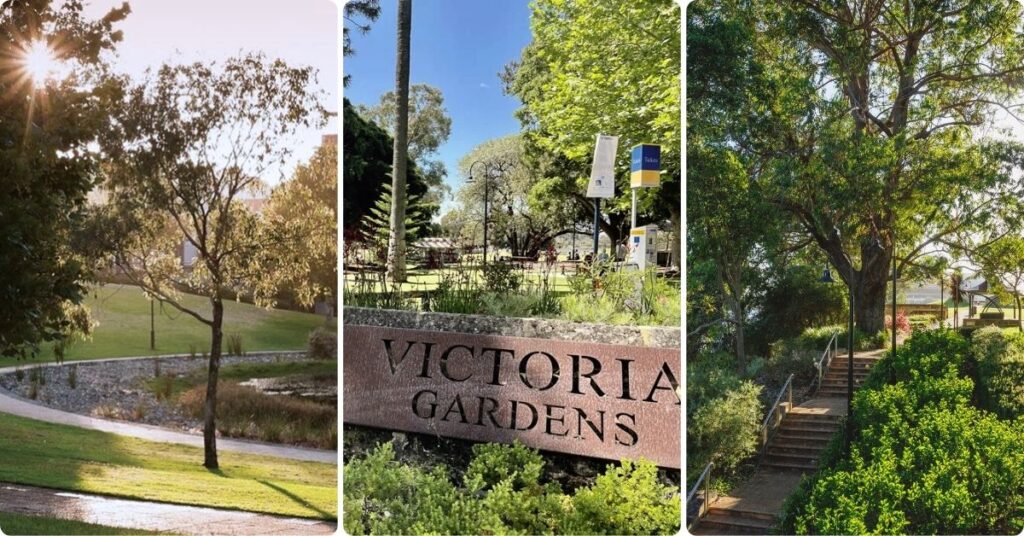
Victoria Gardens Perth sits just five minutes from the CBD, offering visitors one of the city’s quietest riverside settings. Located at 10 Royal Street in East Perth, this free heritage park has been drawing locals and travellers for over 150 years, and a 1990s redevelopment transformed it into the polished riverside destination you’ll find today.
What Makes Victoria Gardens Special
Victoria Gardens is known for two things: its heritage significance and its direct sightline to the iconic Matagarup Bridge. The park retains original plantings from the 1800s, including towering Bunya Pines and Southern Mahogany trees (Eucalyptus botryoides) that have witnessed Perth’s entire growth. These 150-year-old specimens aren’t just visually striking, they’re a living connection to the park’s establishment as one of Perth’s earliest gardens.
The real visual anchor, though, is Matagarup Bridge. Completed in 2018, this 370-metre pedestrian suspension bridge rises 72 metres above the Swan River with a dramatic 160-metre central span. Its fluid, sweeping arches evoke the shape of black and white swans or the Wagyl, the Aboriginal rainbow serpent central to Whadjuk Noongar Dreaming stories. From Victoria Gardens, the bridge is impossible to miss, particularly after dark when its architectural lines illuminate across the river.
Facilities and What to Bring
This is a fully serviced park, so a picnic or casual day out is straightforward. You’ll find public toilets, picnic tables, and barbecue facilities scattered throughout the grounds. There’s a kids’ playground for families, open lawns suitable for games or relaxation, mini gym equipment if you want to exercise, and walking paths that meander through the gardens and down to the river’s edge.
If you don’t want to bring your own food, the adjacent Claisebrook Cove precinct has multiple cafes and restaurants within walking distance, many with river views. It’s a convenient setup: you can park at the gardens, visit a cafe, and return to the park without needing to move your car.
Parking and How to Get There
Victoria Gardens has dedicated parking on-site at a City of Perth car park. The rate is $5.00 per hour from 4am to 5:59pm, with free parking from 6pm to 3:59am. Disability parking bays are available if needed.
For those without a car, the free Yellow CAT bus (Perth Central Area Transit, route 3) stops directly outside the park on Royal Street. It runs on a circular loop connecting East Perth to West Perth via the CBD, with services every 6 minutes during weekdays and every 8 minutes on weekends. This makes Victoria Gardens genuinely car-free accessible, which we find valuable for solo travellers or those wanting a hassle-free outing. East Perth Station is also nearby if you’re arriving by regional train.
Indigenous Cultural Context: Whadjuk Country
Victoria Gardens and the surrounding Claisebrook Cove area sit on Whadjuk Noongar Country. The Whadjuk Noongar people have occupied this 6,700-square-kilometre territory for at least 45,000 years continuously. Before European settlement, the area where the gardens now stand was known as Goon’goong’up, a narrow freshwater stream so shallow you could step across it. In Whadjuk Noongar language, the Claisebrook Cove area is called Dyoondalup.
The name Matagarup itself comes from Whadjuk Noongar language, meaning “place where the river is only leg deep, allowing it to be crossed.” This naming honours the cultural significance of the Swan River to the local Noongar community.
During the 1990s redevelopment of Victoria Gardens and Claisebrook Cove, a team of Aboriginal and European artists and landscape architects collaborated to create Ngango Batta’s Moonditcher, a special dreaming path through the gardens. This integration of Whadjuk cultural knowledge and contemporary design reflects the site’s significance for both Aboriginal and European peoples, and its success as a shared public space.
A Park Transformed: From 1800s Garden to Modern Precinct
Victoria Gardens was established in the 1800s as one of Perth’s earliest parks, but by the 1980s it had fallen into disrepair. The 1990s redevelopment as the centrepiece of Claisebrook Cove Village was a turning point. The transformation preserved the heritage trees, refurbished the landscape, and created the modern riverside precinct you see today. Visitors often remark on how well maintained the grounds are now, with manicured lawns and gardens that feel both historic and current.
Matagarup Bridge: A Visual Landmark Worth Both Day and Night
The Matagarup Bridge sits directly across the Swan River from Victoria Gardens and is accessible via a walking path from the park. The bridge itself is a 370-metre feat of design, with architects Parry & Rosenthal Architects and Denton Corker Marshall creating a structure that uses only two concrete piers in the river, minimising environmental impact.
During daylight hours, the bridge’s geometric arches stand out against the sky. At night, when illuminated, it transforms the entire river outlook. Many locals time their park visit to catch the bridge lit up, particularly if visiting in summer when dark arrives later in the evening. From Victoria Gardens, you also get clear views across to Optus Stadium on Burswood Peninsula, which is equally striking after sunset.
Family-Friendly Amenities and Accessibility
Victoria Gardens is fully wheelchair accessible, with accessible parking, accessible pathways throughout, and public toilets. The playground is suitable for younger children, and the open lawns give families plenty of space to spread out. If you’re picnicking, the barbecue facilities mean you can cook rather than rely on takeaway food.
The mini gym equipment is free to use and scattered throughout the park, making it convenient if you want to combine a walk with some outdoor fitness. Cycling paths are also available, so the gardens work well for families mixing different activities in one visit.
The Heritage Trees: Living History
The Bunya Pines (Araucaria bidwillii) are the most visually distinctive trees in the park. Native to Queensland, they grow tall and coniferous, creating a towering presence in the landscape. The Southern Mahogany specimens (Eucalyptus botryoides), native to Australia, contribute to the park’s canopy and ecological value. Both species are heritage specimens estimated at 150 years or older, having been planted in the original 1800s establishment.
These trees are significant on two counts: they anchor the park’s heritage identity and they provide valuable shade during Perth’s warm months. In summer, the dappled shade under these mature trees becomes a genuine asset when afternoon temperatures climb toward 35°C.
When to Visit: Seasonal Considerations
Perth’s climate is mild year-round, which means Victoria Gardens is pleasant to visit in any season. Spring (September to November) and autumn (March to May) offer the most comfortable temperatures, ranging from 18 to 25°C. These are ideal for extended walks and picnics.
Summer (December to February) can be hot, with temperatures regularly between 25 and 35°C, though the strong afternoon sun is part of the appeal for evening visits. Many locals time summer visits to late afternoon or evening specifically to see the Matagarup Bridge and Optus Stadium lights come on. The shade under the heritage trees is valuable during this period.
Winter (June to August) is mild, typically 10 to 18°C, with occasional rain. The park is quieter and offers softer, more photogenic light if you’re interested in photography. Note that the shared-use paths are occasionally subject to flooding during heavy rain, and warning signs are deployed when hazards are present.
Combining Victoria Gardens with Other East Perth Activities
Victoria Gardens doesn’t have to be your entire outing. The park connects easily to several nearby destinations. Claisebrook Cove, immediately adjacent, hosts cafes, public art installations, and the Claisebrook Cove Art Walk, a 5.4-kilometre integrated trail through the redeveloped precinct. You can walk from Victoria Gardens directly into the art walk.
The Matagarup Bridge itself is directly accessible from the park and connects you to Optus Stadium and the Burswood Peninsula, both with their own attractions. East Perth Station, the region’s transport hub, is within walking distance. The Swan River paths extend outward from the gardens in both directions, offering longer walking or cycling loops toward Heirisson Island and the broader riverside trail network.
Practical Information and Contact
Victoria Gardens is open daily. While specific opening hours aren’t formalised, you can contact the City of Perth on (08) 9461 3333 to confirm hours and check on any maintenance or closures.
Parking is available on-site at $5.00 per hour (4am to 5:59pm) and free from 6pm to 3:59am. The free Yellow CAT bus stops on Royal Street directly outside the park. All facilities, including toilets, picnic areas, playground, and walking paths, are free to use.
Frequently Asked Questions
Is Victoria Gardens really free to enter?
Yes, entry is completely free. You pay for parking if you drive, but there’s no admission fee to use the park or its facilities.
Can I bring a dog to Victoria Gardens?
Contact the City of Perth on (08) 9461 3333 to confirm whether dogs are welcome and if there are any restrictions.
What are the best facilities for a family picnic?
The park has picnic tables, barbecue facilities, public toilets, and a playground. Bring your own food or visit the nearby Claisebrook Cove cafes. The open lawns give families plenty of space.
How long should I plan to spend at Victoria Gardens?
A walk through the gardens and down to the river can take 30 to 60 minutes. If you’re picnicking, relaxing on the lawns, or exploring the heritage trees in detail, budget two to three hours.
Is the Yellow CAT bus reliable?
The Yellow CAT runs every 6 minutes on weekdays and every 8 minutes on weekends. It’s a free service managed by Transperth, making it a reliable way to reach the park from the CBD or other East Perth locations.
What makes Matagarup Bridge special?
Matagarup Bridge is a 370-metre pedestrian suspension bridge completed in 2018. Its arches evoke the shape of black and white swans or the Wagyl (Aboriginal rainbow serpent). The name comes from Whadjuk Noongar language. It’s dramatically visible from Victoria Gardens, especially at night, and connects the park to Optus Stadium.
Are the heritage trees old?
The Bunya Pines and Southern Mahogany specimens in Victoria Gardens are estimated at 150 years or older, dating to the original 1800s plantings. They were preserved during the 1990s redevelopment.
Can I visit in summer?
Yes, though summer temperatures (25 to 35°C) can be intense during midday. Early morning or late evening visits are more comfortable, and the heritage tree shade becomes valuable. Summer evenings are popular for viewing the illuminated Matagarup Bridge.
Is there disabled access?
Yes. Victoria Gardens is fully wheelchair accessible with accessible parking, accessible pathways throughout the gardens, and public toilets. Contact City of Perth on (08) 9461 3333 if you need specific facility confirmation.
What other attractions are nearby?
Claisebrook Cove (cafes, public art, history), Matagarup Bridge (walking, photography), Optus Stadium, Swan River walking trails, East Perth Station, and the Claisebrook Cove Art Walk (5.4km trail) are all within easy reach or directly connected.
Final Thoughts
Victoria Gardens represents a successful blend of heritage preservation and contemporary urban design. It’s free to enter, genuinely accessible by public transport, and offers a real riverside experience within five minutes of Perth’s CBD. Whether you’re after a quiet spot to sit and think, a family outing with kids, a photography location, or a picnic launch point for exploring the broader Claisebrook Cove precinct, the gardens deliver. The heritage trees remind you of Perth’s deep history, while Matagarup Bridge and the thoughtful Whadjuk Noongar integration reflect how the city continues to evolve.