
Officially, this suburb is called Butler, after John Butler, the explorer who first charted the Wanneroo and Lake Joondalup area back in 1834. Unofficially, plenty of locals still call it Brighton, the marketing name developer Satterley slapped on its sprawling residential estate here, and the name stuck hard enough that residents petitioned the City of Wanneroo in 2003 to make it official. The council said no, ruling that “Brighton” was both a duplicate of half a dozen other Australian suburbs and had no genuine historical connection to the place. Two decades on, the Brighton name lives on in shopfronts and shopping centre signage even as the suburb itself remains, on every map and every piece of council paperwork, stubbornly Butler.
Butler Suburb Map
Quick Facts
| Local Government Area | City of Wanneroo |
| Distance from Perth CBD | Approx. 41km north |
| Postcode | 6036 |
| Population | 13,473 (2021 Census) |
| Median House Price | $820,000 |
| Annual Growth | 19.7 percent (sales); 7.7 percent (rental) |
| Known For | Named after explorer John Butler; the “Brighton” rebrand residents wanted but never got; Butler railway station (Joondalup line terminus) |
| Land Area | 5km² |
Who It Suits
Butler suits young families and first-home buyers wanting genuine train access, a large purpose-built shopping precinct, and a strong sense of established community despite the suburb’s relative youth. It’s a strong fit for buyers who want direct rail connectivity into Perth without paying inner-suburb prices. It’s a less natural fit for buyers wanting heritage character or a quiet, low-density feel, since Butler is a busy, densely developed district centre built almost entirely within the last two decades.
The Suburb Everyone Wanted to Call Brighton
Butler was gazetted all the way back in 1979, but for over two decades it remained exactly what it had always been: unpopulated bushland with no proper roads and no reason for anyone to visit. That changed in 2002, when the City of Wanneroo approved the Butler-Ridgewood Agreed Local Structure Plan, clearing the way for developer Satterley to begin subdivision in 2003. Satterley marketed its new residential project as the “Brighton Estate,” and the branding was thorough: shops, a newsagency, and other local businesses all adopted the Brighton name, to the point where longtime residents and visitors alike genuinely struggled to tell which name was official. In 2003, residents formally petitioned the council to make the switch permanent. The City of Wanneroo rejected it, citing both the name’s duplication with numerous other Brightons across Australia and its lack of any real historical or cultural link to the area, leaving Butler’s official name unchanged while “Brighton” continued to appear on shopfronts regardless.
The Butler Growth Story
Butler was essentially unpopulated at the 2001 Census, reached 5,056 residents by 2006, and had rocketed to 9,653 by 2011, a jump of more than 90 percent in five years. Growth continued through 13,278 residents by 2016 and 13,473 by the 2021 Census, cementing Butler’s status as one of the fastest-built suburbs in Perth’s history.
Satterley’s Brighton Estate ultimately spanned four sub-divisional precincts, The Dunes, The Green, Seahaven and Junctions North, with over $120 million spent on landscaping, civil works and community infrastructure including the Brighton Village Shopping Centre and the Central Park Precinct. Reflecting its scale, the state’s Directions 2031 urban expansion plan formally designated Butler a “district centre,” a hub for commercial activity and public services second only to the larger town centres of Clarkson and Alkimos nearby.
Life in Butler Day to Day
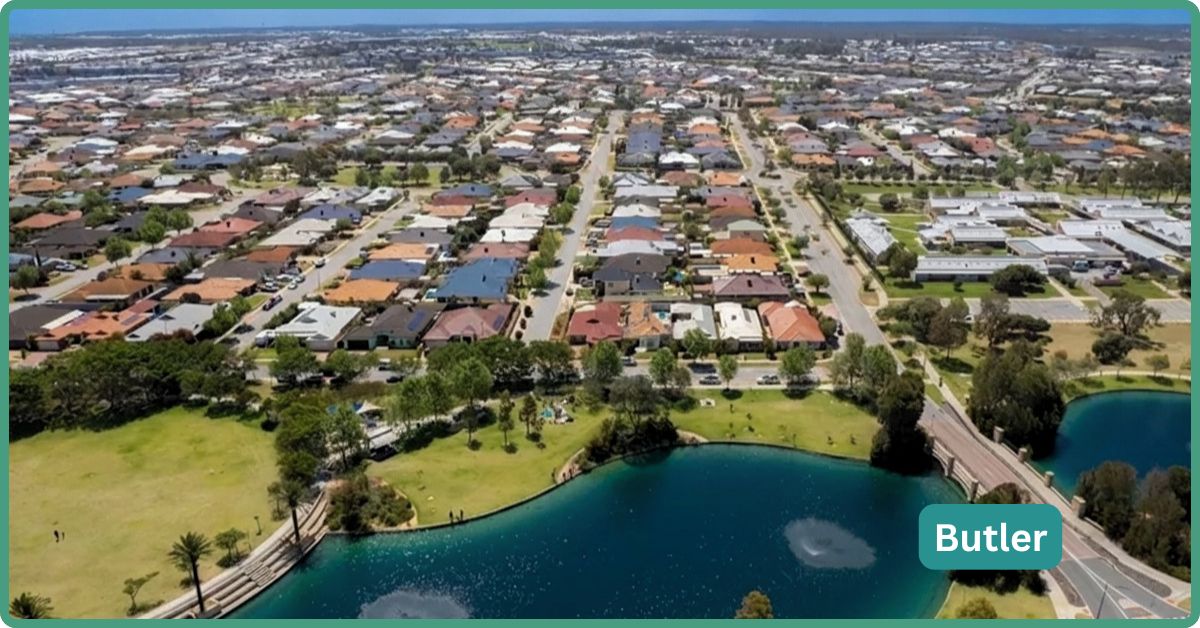
Kingsbridge Boulevard forms the retail and social spine of the suburb, home to a strip of shops, banks and public services alongside a large Coles supermarket. The Cornerstone Tavern, which opened here in 2010, has become the main nightlife and entertainment venue for the wider Butler-to-Jindalee area, giving residents a genuine local pub rather than a drive to somewhere else. Most of Butler’s commercial amenity sits toward the suburb’s western edge near Marmion Avenue, while the eastern half remains almost entirely residential in character.
Parkland runs the length of Kingsbridge Boulevard, and the Butler Community Centre in the suburb’s south provides a further hub for local groups and events. For families wanting a Sunday coffee or a school-holiday outing, the combination of Brighton Village Shopping Centre and the nearby coast, just 2 kilometres west, gives Butler a genuinely liveable everyday rhythm despite its relative newness.
Politically, Butler has followed the classic “mortgage belt” pattern common to Perth’s fast-growing outer suburbs, voting Labor at state elections while leaning Liberal federally, a split reflecting the suburb’s young, working, first-home-buyer demographic.
Realty Market
REIWA data current to July 2026 puts Butler’s median house price at $820,000, up a strong 19.7 percent over the past year, with rental growth of 7.7 percent taking median rent to $700 a week. Two-bedroom houses carry a median of $660,000, three-bedroom homes $750,000, and four-bedroom homes $897,000, with an upper quartile of $908,000 and a lower quartile of $725,000. Houses are moving quickly, with a median time on market of just 11 days for houses and 7 days for units, a clear sign of sustained buyer demand. REIWA’s own population figure of 13,278 sits just slightly below the ABS 2021 Census count of 13,473, a small and unremarkable gap reflecting the normal lag between data collection cycles.
Nearby suburb growth confirms the wider Brighton-Alkimos corridor is genuinely on fire: Jindalee grew an extraordinary 29.3 percent over the past year, Alkimos grew 18.1 percent, Merriwa grew 17.2 percent, and Quinns Rocks grew 14.8 percent, placing Butler’s own 19.7 percent squarely within one of the hottest growth pockets anywhere in the Perth market.
Hospitals and Healthcare Nearby
Butler does not have its own hospital, but Joondalup Health Campus is accessible via the Mitchell Freeway and Marmion Avenue, giving residents access to a major hospital serving the northern corridor. Local GP clinics and pharmacies within the Brighton Village and Kingsbridge Boulevard precincts cover everyday healthcare needs for the suburb’s large, young population.
Schools and Education
Butler is unusually well served by schools for its size. Three government K-6 primary schools serve the suburb: Butler Primary School, East Butler Primary School and John Butler Primary College, alongside the government secondary option, Butler College, just 0.5 kilometres from the suburb centre. St Francis of Assisi Catholic Primary School, a non-government school, sits 0.2 kilometres away, and Irene McCormack Catholic College, a private K-7 through Year 12 school, is 0.4 kilometres from the centre, giving families a genuine choice between public and Catholic education without leaving the local area.
Industry and Work Life
As a designated district centre under the state’s Directions 2031 plan, Butler carries more local commercial weight than a typical residential suburb, with Kingsbridge Boulevard’s shops, banks and services providing meaningful local employment alongside the Brighton Village Shopping Centre. Most working residents still commute out via the Mitchell Freeway or the Joondalup line, whether south to Perth’s CBD or to nearby employment hubs in Joondalup and Clarkson, but Butler’s own commercial base is genuinely more developed than most suburbs of comparable age.
Parks and Greenspaces
Butler contains several parks scattered throughout its residential estates, including a continuous strip of parkland running the length of Kingsbridge Boulevard, giving the suburb’s busy commercial spine a genuine green counterpoint. With the Indian Ocean just 2 kilometres to the west, residents also have ready access to coastal open space without needing to leave the immediate area.
Transport
Butler railway station, on the Joondalup line, opened in 2014 in the suburb’s north and was the line’s terminus until Yanchep station opened in 2024. The line gives residents a direct rail link through Joondalup to Perth and onward to Mandurah. It takes around 444 minutes into the Perth CBD.
The station is served by six Transperth bus routes, including routes 483 and 484 running south to Clarkson station, and routes 487 and 488 running north to the Alkimos Trinity estate.
The Mitchell Freeway forms Butler’s eastern boundary, with a dedicated interchange at Butler Boulevard, while Marmion Avenue runs along the suburb’s western edge, connecting north to Yanchep and south through the coastal corridor.
Trade-Offs to Weigh
Butler’s strengths are genuine train access, a large and well-developed shopping precinct, strong school options across both government and Catholic systems, and sustained price growth from an accessible base. Its trade-off is distance, at 41 kilometres from the Perth CBD it’s one of the further-out suburbs, and its dense, young demographic profile won’t suit buyers seeking a quieter, more established feel. Buyers should also be aware of the ongoing Brighton-versus-Butler naming confusion, a minor but real quirk of daily life here. For buyers prioritising rail access, strong local amenity and continued growth potential over inner-suburb proximity, Butler is a genuinely strong contender.
The Honest Verdict
Butler went from empty bushland to a suburb of 13,000-plus residents in under two decades, and its designation as an official district centre has given it a stronger commercial backbone than most suburbs its age. With sales growth of 19.7 percent over the past year and genuine train access via its own station, Butler remains one of the more compelling options in Perth’s fast-growing northern corridor, Brighton naming confusion and all.
Frequently Asked Questions
Why is Butler sometimes called Brighton?
Developer Satterley marketed its residential estate here as the “Brighton Estate,” and the name became so widely used that residents petitioned the City of Wanneroo in 2003 to make it official. The council rejected the request, and the suburb’s official name remains Butler.
What is the median house price in Butler?
REIWA data current to July 2026 puts the median at $820,000, up 19.7 percent over the past year, with median rent at $700 a week.
Does Butler have a train station?
Yes. Butler railway station, on the Joondalup line, opened in 2014 and currently serves as the line’s terminus, with direct rail access to Perth and Mandurah.
What schools are in Butler?
Butler has three government primary schools, a government secondary college, and two Catholic schools, giving families a genuine choice of nearby education without leaving the suburb.
References
Australian Bureau of Statistics (abs.gov.au) 2021 Census SAL data for Butler. Current property market and school data sourced from the REIWA suburb profile for Butler. Local government context confirmed via the City of Wanneroo website. For nearby suburb profiles in this series, see the Alkimos Profile and the Quinns Rocks Profile.