
Stand on Mount Eliza and Perth spreads out below: the Swan River, the CBD skyline, the Darling Range in the distance. This is Kings Park, 400 hectares of parkland, botanic garden and native bushland right at the edge of the city, free to enter and open around the clock. It draws millions of visitors a year and consistently ranks as Perth’s top-rated attraction, but most people treat it as a quick photo stop rather than the half-day (or full-day) destination it actually rewards.
The park sits on Wadjuk Noongar Country overlooking the river and CBD, and it’s three different experiences layered together: sweeping city and river views, real native WA bushland covering roughly two-thirds of the park, and enough space that even on a busy day you can find a quiet stretch.
Who It Suits
Almost everyone, which is part of why it’s Perth’s most visited attraction: families (six dedicated playgrounds across the park), photographers chasing river and canopy views, bushwalkers wanting real WA flora without leaving the city, and wildflower enthusiasts during September’s Kings Park Festival. It’s a poor fit only if you’re after a quick five-minute stop; the park rewards a few hours over a rushed drive-through.
Kings Park Map
The map highlights Kings Park and the Western Australian Botanic Garden, showing its walking and cycling paths, roads, car parks, attractions, picnic areas, facilities and points of interest. You can also easily find playgrounds, lookouts, gardens and visitor amenities across the park. Map comes via bgpa.wa.gov.au. Use the controls to zoom or download the image here.
The Must-Do Features
DNA Tower
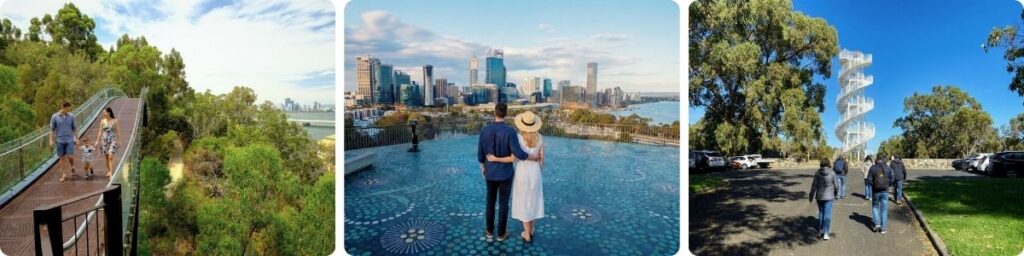
A distinctive white double-helix staircase, 15 metres tall with 101 steps, positioned at one of the park’s highest points on Mount Eliza. The tower itself isn’t large, but because it sits atop the escarpment, the view from the top is sweeping: city, river, escarpment and, on a clear day, out toward the coast. It’s about a 15-minute walk from the main entrance on a wide, shaded path.
Lotterywest Federation Walkway
The park’s most photographed single feature: a 620-metre walkway with a 222-metre elevated aerial section, including a 52-metre glass and steel arched bridge reaching a maximum height of around 16 metres through the eucalyptus canopy. It puts you at eye level with branches and treetop bird activity rather than looking up from the ground. Early morning (around 9 to 10:30am) is the quietest window; late afternoon brings longer shadows and richer forest colour. It’s about a 20-minute walk from the main entrance.
State War Memorial precinct
The Pool of Reflection and Flame of Remembrance sit within a quieter, more contemplative section of the park, framing river views with a different mood than the busier Federation Walkway and DNA Tower areas.
Western Australian Botanic Garden
The Western Australian Botanic Garden forms the horticultural heart of Kings Park, occupying a large area overlooking the Swan River and Perth city. Established to showcase Western Australia’s remarkable native flora, the garden combines landscaped displays with natural bushland, winding walking paths, water gardens, memorials, lookouts and distinctive features such as the elevated glass bridge. It provides a more cultivated and immersive contrast to the surrounding bushland of Kings Park, while giving visitors an opportunity to experience the diversity of Western Australian plants within the park itself. Best of all, there is not entry fee.
Bushland
Roughly two-thirds of Kings Park is native WA bushland rather than manicured garden, with over 3,000 plant species represented across the park overall. The Bushland Nature Trail, a 900-metre, roughly 30-minute walk, drops you into scrub, wildflowers and native birdlife rather than a curated landscape, a different feel from the more polished sections near the main entrance. The Law Walk, starting at Karri Pavilion and following the limestone escarpment ridge, is a good option if you want a quieter stretch away from the park’s busiest paths.
For Families
Kings Park has six dedicated playgrounds spread across the park, each with a distinct character. Synergy Parkland, near the Kiosk, is built around life-sized replicas of extinct Australian megafauna and suits kids roughly aged 3 to 12. May Drive Parkland steps things up with an elevated walkway, an island fort and an interactive water-misting area, better suited to kids 6 and up who are comfortable with height and movement. Rio Tinto Naturescape leans into unstructured nature play, climbing rocks, ropes and a shallow creek, and tends to hold kids aged 5 to 12 for hours. Variety Place is purpose-built as an inclusive, accessible playground for kids with varying abilities. Picnic areas, barbecue zones and toilets are spread generously across the park, so a family day doesn’t need much advance planning beyond bringing food or budgeting for the on-site kiosk and cafe.
Getting There
Kings Park sits just 1.5km from the Perth CBD, and public transport is the easiest way in. Transperth bus route 935 runs from St Georges Terrace right into the heart of the park at the Fraser Avenue precinct, roughly every 10 minutes on weekdays and 15 on weekends, taking around 6 to 14 minutes, and it’s free to ride. The free Blue CAT bus also connects from Perth Busport via Perth Station and Elizabeth Quay Bus Station, with extended evening services during the Kings Park Festival in September and for events like Lightscape. If you’re coming from the University of WA or QEII Medical Centre side, the Purple CAT runs between Elizabeth Quay Bus Station and UWA via Kings Park Road. Walking from Perth Station takes about 19 minutes if you’d rather cover the whole distance on foot.
Driving takes about 5 minutes from the CBD. The main car park is Wadjuk Carpark, behind Fraser’s Restaurant, with free parking capped at 4 hours (enforced 7am to 4pm, Monday to Friday, excluding public holidays); other formal car parks are scattered through the park off Kattidj Close and along May Drive, plus disabled parking at Fraser Avenue, Forrest, Botanic Garden, Roe, Zamia and Kulbardi car parks (ACROD permit required). Note that parking, stopping and standing are prohibited on Fraser Avenue itself at all times. A taxi and rideshare pick-up/drop-off point sits behind Fraser’s Restaurant and Aspects of Kings Park on Fraser Avenue. Parking fills quickly during the September festival and major evening events, when the bus or Blue CAT is the better option.
What Locals Know
Regulars know the DNA Tower’s actual height is modest, it’s the elevation of Mount Eliza itself doing most of the work, so don’t expect a towering structure, just a good view from a fairly compact staircase. Locals visiting during the September festival arrive early on weekday mornings specifically to beat both the crowds and the parking crunch, since the park draws hundreds of thousands of extra visitors across the month. For a quieter version of Kings Park at any time of year, locals point first-timers toward the Bushland Nature Trail or the Law Walk over the busier Federation Walkway and DNA Tower precinct, both of which get crowded on weekends and during the festival.
Combine With Nearby Perth
The Bell Tower and Elizabeth Quay are both within a 25 to 30-minute walk via the river path, workable if you want to extend a Kings Park visit into a broader CBD afternoon. Subiaco, a short drive or walk away, has a stronger dinner scene than the park’s own dining options if you’re after a proper evening meal to finish the day.
When to Visit
September brings the Kings Park Festival, running annually since 1964 and one of Australia’s longest-running festivals, with wildflower displays across the park’s 3,000-plus species reaching their peak mid-month; arrive on weekday mornings if you want to avoid the heaviest crowds. October and November still have wildflowers at lower density with considerably fewer visitors, a good quieter alternative if you can’t make the festival itself. Summer (December to February) is hot, so an early start is worth it if you’re walking rather than just visiting a lookout. Autumn (March to May) is underrated: mild weather, low crowds and good light for the bushland walks. Winter (June to August) is mild by Perth standards and often the quietest season overall, good for birdwatching if you don’t mind occasional rain.
Is It Worth It?
Yes, and it’s arguably the single best free thing to do in Perth. Budget at least two to three hours to properly see the DNA Tower, Federation Walkway and one bushland trail, and treat a 30-minute drive-by visit as a missed opportunity rather than the full experience. Come back during the September festival if wildflowers interest you, but know that the rest of the year offers a quieter, still beautiful version of the same park.
Frequently Asked Questions
Is Kings Park actually free?
Yes, entry is completely free and the park is open 24 hours. Some Kings Park Festival activities may have optional costs, but walking the park, using the playgrounds and walking the trails costs nothing.
How long should I spend here?
Two to four hours covers the major features comfortably. A full day is easy to justify with multiple trails, picnicking, or a festival visit.
How do I get there without a car?
Bus 935 from St Georges Terrace in the CBD is the simplest option, running roughly every 10 to 15 minutes and free to ride, dropping you right at Fraser Avenue. The free Blue CAT also connects from Elizabeth Quay and Perth Station, and the Purple CAT links in from UWA and QEII Medical Centre via Kings Park Road.
When is wildflower season?
September is the peak, with the Kings Park Festival running the full month. October and November still have wildflowers at lower density and considerably smaller crowds.
How tall is the DNA Tower, really?
Around 15 metres, with 101 steps. The dramatic view comes from its position atop Mount Eliza rather than the tower’s own height.